📸 Photo Description
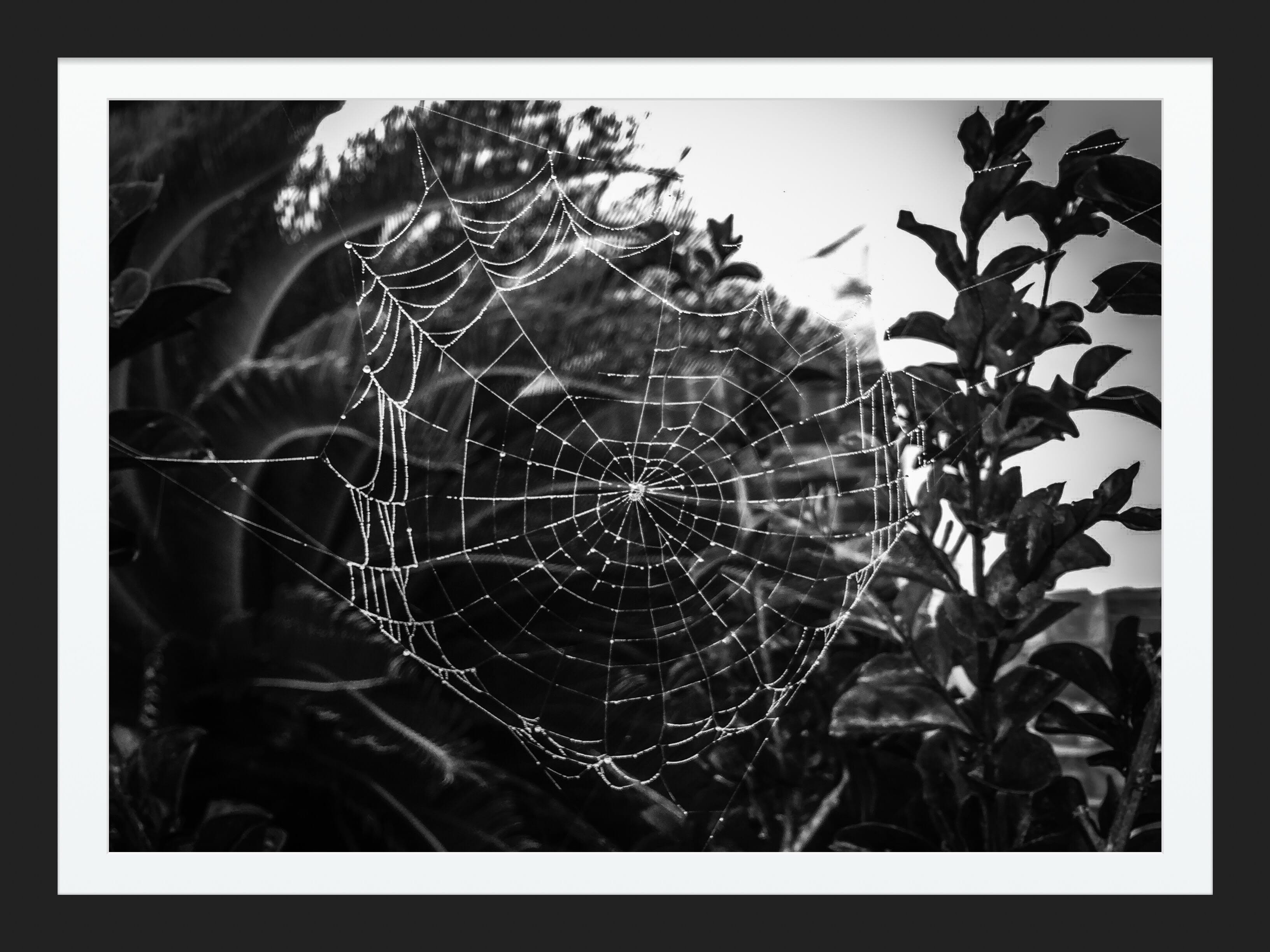
This black and white photograph shows a delicate spider web covered in tiny water droplets or dew. The web is stretched between plants and appears perfectly symmetrical, with the spider's careful thread work clearly visible. The droplets make the web stand out against the blurred background, helping us see this amazing structure that spiders build to catch food.
🔬 Scientific Phenomena
Anchoring Phenomenon: A spider web structure with visible geometric patterns and morning dew.
Why This Happens: Spiders produce silk from special structures in their bodies called spinnerets. This silk is incredibly strong and flexible—stronger than steel of the same thickness! Spiders instinctively arrange their silk in a circular, web-like pattern because this design is very efficient at catching insects. The water droplets (dew or morning moisture) collect on the web strands, making the normally invisible web visible to our eyes. The spider positions itself on the web to feel vibrations when insects get stuck, alerting the spider to its caught prey.
📚 Core Science Concepts
- Animal Structures and Functions: Spiders have special body parts (spinnerets) that produce silk. This is an example of how animals have specific structures that help them survive and meet their needs.
- Design in Nature: The spider web's circular, geometric pattern is not random—it serves a purpose. This demonstrates how organisms use efficient designs to solve problems (catching food).
- Life Cycles and Behaviors: Web-building is an inherited behavior—baby spiders know how to build webs without being taught. This instinctive behavior helps spiders find food.
- Properties of Materials: Spider silk has unique properties: it's stretchy, strong, and sticky in some species. Understanding material properties helps us understand how animals use materials from their own bodies.
Pedagogical Tip:
Consider starting with a sensory observation activity before diving into explanations. Have students observe a real spider web (or the photo) and describe what they see, hear, and feel (without touching the web itself) before you introduce the "why." This anchors their learning in observable phenomena and builds curiosity naturally—the foundation of scientific thinking.
UDL Suggestions:
Representation: Provide students with tactile models of webs (yarn stretched on cardboard frames) so kinesthetic learners can feel the structure. Some students may benefit from labeled diagrams showing the spider's body and spinnerets. Action & Expression: Allow students to demonstrate understanding through drawing, building models with string, or even acting out a spider's web-building movements. Engagement: Connect to student interests by asking, "Have you ever seen a web? Where? What did it look like?" This personalizes the learning and validates diverse observations.
🎓 NGSS Connections
Performance Expectation:
3-LS1-1: Develop models to describe that organisms have unique and diverse life cycles but all have in common birth, growth, reproduction, and death.
Disciplinary Core Ideas:
- Growth and Reproduction of Organisms
- Information Processing
Crosscutting Concepts:
*
*
---
💬 Discussion Questions
- What do you think the spider uses its web for, and why do you think the web is made in a circular shape?
(Bloom's: Analyze | DOK: 2)
- If you could change one thing about the spider web's design, what would it be and why?
(Bloom's: Evaluate | DOK: 3)
- How is a spider web similar to and different from a bird's nest?
(Bloom's: Compare/Contrast | DOK: 2)
- What do you observe about the dew on the web, and what might the water tell us about when this photo was taken?
(Bloom's: Observe & Infer | DOK: 1–2)
📖 Vocabulary
- Spider silk: A strong, stretchy material that spiders produce from their bodies to build webs and catch food.
- Spinnerets: Tiny body parts on spiders that produce and spin silk into thread.
- Web: A structure made of silk threads arranged in a pattern to catch insects for food.
- Inherited behavior: An action or skill that an animal knows how to do without being taught, passed down from parents.
- Dew: Tiny water droplets that form on plants and objects early in the morning or late at night when it's cool.
- Geometry: The shapes and patterns we see in nature, like the circular design of a spider web.
🌡️ Extension Activities
- Web-Building Challenge: Provide students with yarn, sticks, and a frame (cardboard or a wire hanger bent into a circle). Challenge them to design and build their own "web" using the yarn. Afterward, discuss: Did you make it circular like a real spider? Was it easy or hard? What problems did you solve? This builds design thinking and appreciation for spider engineering.
- Dew Observation Walk: Take students on a nature walk on a dewy morning (or after the sprinkler runs). Have them locate spider webs and observe the water droplets. Discuss why the dew makes the web visible. Sketch or photograph what they find. This connects classroom learning to real-world observation.
- Spider Web Symmetry Art: Provide students with dotted circle templates and have them create their own symmetrical web designs using markers, string, or paint. Challenge them to make their web pattern match a real spider web. Discuss symmetry and patterns in nature. This integrates art and geometry while reinforcing the web's structural design.
🔍 Zoom In / Zoom Out Concepts
Zoom In: The Spinnerets (Microscopic Level)
If we could zoom in really close—like looking through a powerful microscope—we'd see the tiny spinnerets on the spider's abdomen. These special body parts are like nature's tiny factories! Inside the spider's body, a special liquid called silk protein is made. When the spider pushes this liquid out through the spinnerets, it hardens into solid silk threads thinner than human hair. The spider can control exactly how much silk comes out and how it's shaped. Even more amazing: different types of silk come from different spinnerets—some silk is stretchy, some is sticky, and some is just for structure. Scientists study spider silk at the microscopic level because it could help us make stronger materials for ropes, parachutes, and even body armor!
Zoom Out: The Forest Ecosystem (Ecosystem Level)
When we zoom out and look at the big picture, we see that this spider web is just one tiny part of a huge living system. The web connects the spider to insects (its food source), to the plants that insects eat, to the birds that might eat the spider, and to the weather patterns that create the dew. A healthy forest needs spiders! They eat thousands of mosquitoes, flies, and other insects that might otherwise harm plants or people. If we removed all the spiders from a forest, the insect population would explode, plants would get damaged, and the whole ecosystem would become unbalanced. The dew visible in the photo also tells us about the ecosystem's water cycle—water from soil and plants rises into the air and condenses on cool surfaces like the web, eventually falling as rain to feed plants and start the cycle again.
🤔 Potential Student Misconceptions
Misconception 1: "All spiders are poisonous and will bite me."
Clarification: Most spiders are harmless to humans and won't bite unless they feel threatened or trapped. Spiders are actually helpful! They eat insects that bug us, like mosquitoes and flies. The venom some spiders have is only for catching tiny insects—it's way too weak to hurt a person. Spiders are more afraid of us than we should be of them. It's important to observe spiders respectfully and from a safe distance, but there's no need to fear them.
Misconception 2: "Spiders make a new web every day, so webs are not important."
Clarification: While some spiders do rebuild their webs regularly (sometimes daily), the web itself is very important and valuable. Spiders use a lot of energy and body resources to make silk, so they try to keep their webs in good condition for as long as possible. When a web gets damaged by wind, rain, or insects, the spider repairs it. Only when the web is too damaged to fix does the spider take it down and build a completely new one. This shows how much effort spiders put into their homes!
Misconception 3: "The dew appears because the spider sprays water on the web to make it sticky."
Clarification: Dew is not made by the spider—it's made by nature! When the air cools down in the early morning or evening, water vapor in the air turns into tiny water droplets that land on cool surfaces like spider webs, leaves, and grass. Some spider silk is naturally sticky (the spider adds stickiness to certain threads), but dew is separate. The dew just makes us see the web better because the water droplets reflect light. The web was always there—the dew just helps us notice it!
🔗 Cross-Curricular Ideas
Math & Geometry:
Have students measure and count the radial threads (spokes) and spiral threads in the spider web photo. Create a simple graph showing how many threads they counted. Then, challenge them to draw their own symmetrical web design on graph paper, focusing on equal spacing and geometric patterns. Discuss how spiders use geometry naturally—without going to math class! This connects structure and function to mathematical thinking.
English Language Arts:
Read aloud The Very Busy Spider by Eric Carle or Are You a Spider? by Judy Allen. After reading, have students write or dictate their own short story from a spider's perspective: "A Day in the Life of a Spider." Encourage descriptive language about the web, the insects caught, and the spider's feelings. Students can illustrate their stories and create a class book. This builds narrative skills while deepening understanding of spider behavior.
Social Studies & Community:
Connect spiders to human communities and "jobs." Discuss: "What job does the spider do in nature? How does it help its community (the forest or garden)?" Then, compare this to human jobs—people also have special skills and do important work to help their communities. Create a classroom chart of "nature jobs" (spider catches insects, bee pollinates flowers, earthworm helps soil, etc.). This builds empathy for all creatures and introduces the concept of interdependence.
Art & Design:
Provide white paint, black paper, and cotton swabs or string to create spider web art inspired by the photo. Students can design their own webs using different materials and then discuss which design is strongest, prettiest, or most efficient. Alternatively, use black paint and white paper to make symmetrical web designs. Display finished artwork alongside the original photo and discuss how artists and engineers both use nature as inspiration for their designs.
🚀 STEM Career Connection
- Arachnologist — Studies spiders and their relatives — how they hunt, build webs and sense the world.
- Try it: Explain how a spider uses its web to catch food, using information from a book or video. (Practice: Obtaining, Evaluating, and Communicating Information)
- Tools: a hand lens, collecting vials, high-speed cameras, a field notebook
- Where they work: forests and gardens, museums, insect labs, universities
- Meet one: Sebastian Echeverri — Why jumping spiders dance, and how their colours look different depending on which of their eyes is watching.
- Median pay: /year — "Zoologists and wildlife biologists"
- Materials Scientist — Invents and tests new materials — stronger, lighter, or able to do something the old ones could not.
- Try it: Describe in your own words why spider silk is a strong material. (Practice: Obtaining, Evaluating, and Communicating Information)
- Tools: electron microscopes, stress testers, furnaces, X-ray diffractometers
- Where they work: research laboratories, manufacturing companies, national labs, universities
- Meet one: Ainissa Ramirez — How to make metal stick to glass and ceramics — she invented a solder that does it.
- Median pay: /year — "Materials scientists"
Wage figures are median annual wages for the U.S. occupation named after each one, from the U.S. Bureau of Labor Statistics, Occupational Employment and Wage Statistics (OEWS), national, May 2025. Several careers share one occupation, so their figures match.
---
Teacher Tip: This lesson pairs beautifully with a live observation activity. If possible, locate or create a spider habitat in your classroom so students can observe web-building behavior over time. Remember to release the spider safely or contact a local naturalist for guidance. Students often develop genuine respect and curiosity about spiders when they observe them directly!