📸 Photo Description
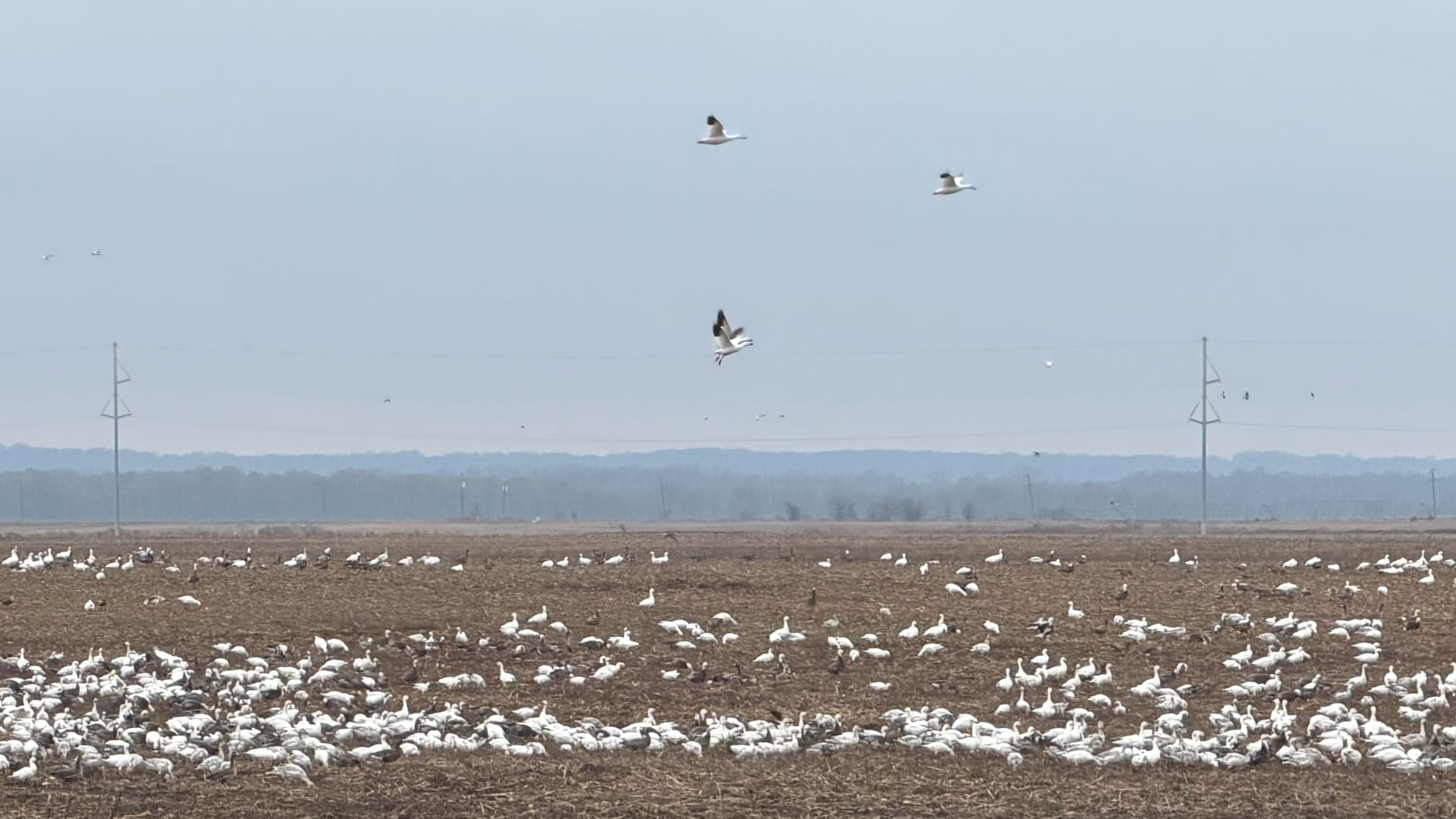
This image shows hundreds of white snow geese resting together in a large open field during their migration journey. Three geese are flying above the group, with power lines and distant hills visible in the background. The geese gather in big groups like this to stay safe, find food, and rest during their long travel between their winter and summer homes.
🔬 Scientific Phenomena
Anchoring Phenomenon: Large-scale bird migration and flocking behavior
Snow geese are traveling thousands of miles between their arctic breeding grounds (summer homes) and southern wintering areas (winter homes). This happens because of seasonal changes in temperature and food availability. As days get longer in spring, the geese sense it's time to fly north where it's warmer and more plants and insects are available for food. They fly in large groups, called flocks, which helps them save energy, spot predators more easily, and share information about good places to rest and eat. This journey happens every year in a predictable pattern—a wonderful example of how animals adapt to changes in their environment.
📚 Core Science Concepts
- Animal Migration: Snow geese travel long distances twice each year following seasonal patterns of temperature and food availability. This is an inherited behavior that helps them survive.
- Adaptation and Survival: Traveling in large groups (flocking) is an adaptation that protects geese from predators, reduces wind resistance during flight, and helps them find food and rest areas more easily.
- Seasonal Changes: Birds respond to seasonal changes in daylight length and weather, which trigger their instinct to migrate. These environmental signals tell animals when it's time to move.
- Habitat and Ecosystems: Snow geese depend on different habitats at different times of year—arctic tundra in summer and wetlands/fields in winter—showing how animals rely on multiple ecosystems throughout their lives.
Pedagogical Tip:
Before diving into migration concepts, activate prior knowledge by asking students: "What do YOU do when it gets cold?" This personal connection helps third graders understand that animals, like humans, change their behaviors based on seasons and weather. You might also do a simple kinesthetic activity where students "fly" together in formation to feel why geese stick together in groups.
UDL Suggestions:
Multiple Means of Representation: Provide a visual migration map showing the route snow geese take (north/south arrows). Use different colors to show summer and winter homes. Some students may benefit from a tactile model (fabric wings, magnetic pieces on a map) to represent migration.
Multiple Means of Engagement: Create a classroom simulation where students become geese—some lead the flock, some follow, and you act as a predator or weather event. This embodied learning helps kinesthetic learners deeply understand why flocking behavior matters.
🎓 NGSS Connections
Performance Expectation:
3-LS1-1: Develop models to describe that organisms have unique and diverse life cycles but all have in common birth, growth, reproduction, and death.
Disciplinary Core Ideas:
- : Growth and Development of Organisms
- : Adaptation
- : Biodiversity and Humans
Crosscutting Concepts:
- : Seasonal migration follows predictable yearly patterns
- : Temperature and daylight changes cause geese to migrate
- : Wing structure and flock formation enable long-distance travel
💬 Discussion Questions
- Why do you think these geese are all gathered together in one big group instead of flying alone? (Bloom's: Understand | DOK: 1–2)
- What do you think would happen to snow geese if winter stayed cold all year and never got warm? (Bloom's: Analyze | DOK: 2–3)
- How is the way snow geese survive winter different from how you survive winter? (Bloom's: Evaluate | DOK: 3)
- These geese fly thousands of miles every year. How do you think they know which direction to fly and where to go? (Bloom's: Analyze | DOK: 2–3)
📖 Vocabulary
- Migration: When animals travel long distances to find food, water, or better weather (usually happening twice a year).
- Flock: A large group of birds that fly and travel together.
- Adaptation: A special body part or behavior that helps an animal survive in its environment.
- Seasonal: Related to the seasons (spring, summer, fall, winter) and the changes that happen during each season.
- Habitat: The place where an animal lives and finds food, water, and shelter.
🌡️ Extension Activities
- Migration Route Mapping: Give students a large map of North America. Mark the arctic breeding grounds in the north (summer home) and southern wintering areas in the south (winter home). Have students draw the migration route with arrows and label what the geese might find at each location (food, water, temperature). Students can add illustrations of plants and other animals found in each habitat.
- Flock Formation Flight Simulation: Take students outside for a safe "flight" activity. Have them line up and walk/jog in a V-formation (like migrating geese). Rotate who leads the group so students experience why flying in formation is easier—the bird in front "breaks" the wind for others. Discuss how this adaptation saves energy during long flights.
- Seasonal Changes Investigation: Create a chart with four columns (one for each season). Have students draw or cut out pictures showing how the same landscape changes through the year (bare trees in winter, green trees in spring, etc.). Discuss how these seasonal changes tell geese it's time to migrate.
🔍 Zoom In / Zoom Out Concepts
Zoom In: Inside a Snow Goose's Body
When snow geese prepare for migration, their bodies undergo amazing changes we can't see! Their muscles get stronger, and they build up special fat reserves (like an internal energy tank) that fuels their long journey. Deep inside, their brains sense changes in daylight length through their eyes, triggering hormones that tell their bodies "it's time to migrate!" This internal biological clock—passed down from parent geese to baby geese—is like a built-in calendar that works year after year, generation after generation.
Zoom Out: Continental and Global Systems
Snow geese migration connects multiple continents and ecosystems! These geese breed in the Arctic tundra (Canada, Alaska, Russia), migrate through central North America, and winter in Mexico and the southern United States. Their journey is tied to global wind patterns, ocean currents that affect temperature, and planetary seasons caused by Earth's tilt. When we zoom out even further, we see that snow geese are connected to climate patterns worldwide—if global temperatures change, it disrupts the timing of their migration and the availability of food at each stop, affecting the entire food chain from plants to predators.
🤔 Potential Student Misconceptions
Misconception 1: "Snow geese fly south because they get cold."
Scientific Clarification: Geese don't actually feel too cold! Their feathers are waterproof and incredibly warm, like built-in winter coats. They migrate because food becomes scarce when water freezes and plants die in winter. It's about finding food, not staying warm. They leave before it gets dangerously cold—their internal clock and decreasing daylight tell them when to go.
Misconception 2: "Baby geese learn migration by watching a map or being taught by humans."
Scientific Clarification: Migration is an inherited behavior, not something geese learn in school! Baby geese are born with an instinct to migrate. The first time they migrate, they follow older, experienced geese in their flock who know the route. Over their lifetime, they learn the specific stops and landmarks, but the urge to migrate comes built-in from their parents' genes.
Misconception 3: "All the geese in the photo are the same age and from the same family."
Scientific Clarification: This flock likely contains geese from many different family groups—thousands of individuals! Geese gather in massive flocks during migration because it helps them all survive together, even though they're not all related. Some are young (hatched this year), and some are old (many years old). They come together temporarily during migration, then split up into smaller family groups at their destination.
🔗 Cross-Curricular Ideas
Math Connection: Counting and Estimation
Challenge students to estimate how many geese are in the photo using strategies like counting a small section and multiplying. Create word problems: "If there are 500 geese in this field and they fly in groups of 25, how many groups are there?" This builds multiplication and division skills while deepening engagement with the image.
ELA Connection: Narrative Writing
Ask students to write a short story from the perspective of a baby snow goose on their first migration: "Dear Diary, Today I flew 200 miles for the first time..." Students can describe what the goose sees, hears, and feels during the journey. This develops descriptive writing while reinforcing migration concepts through creative expression.
Social Studies Connection: Map Skills and Geography
Use this image to teach map skills by having students locate snow goose migration routes on maps of North America. Discuss different habitats: "What do you think the Arctic looks like compared to this field?" Students can research and present on the different countries and regions geese travel through, building geography and cultural awareness.
Art Connection: Movement and Patterns
Have students create artwork showing the V-formation flight pattern using various media (paint, collage, chalk). They can also illustrate the four seasonal landscapes that geese encounter during their year-long cycle. This combines artistic expression with reinforcing the repeating pattern of seasonal migration and adaptation.
🚀 STEM Career Connection
- Ecologist — Studies how living things depend on each other and on the place they live.
- Try it: Design a model of a wetland habitat that snow geese could use for resting and feeding, explaining why each part is important. (Practice: Constructing explanations and designing solutions)
- Tools: quadrat frames, measuring tapes, GPS units, a field notebook
- Where they work: forests, grasslands, wetlands, universities
- Meet one: Sandra Díaz — What a plant's leaves, wood and shape tell you about how it lives — and how those traits add up across a whole ecosystem.
- Median pay: /year — "Environmental scientists and specialists, including health"
- Conservation Scientist — Looks after land, forests and water so they stay healthy for the people and animals who use them.
- Try it: Propose a plan to help protect snow goose migration routes, considering the challenges they face. (Practice: Constructing explanations and designing solutions)
- Tools: soil samplers, aerial photographs, measuring tapes, mapping software
- Where they work: forests and rangelands, parks departments, government agencies, land trusts
- Meet one: Tierra Curry — Which plants and animals are closest to disappearing, and what it takes to save them.
- Median pay: /year — "Conservation scientists"
Wage figures are median annual wages for the U.S. occupation named after each one, from the U.S. Bureau of Labor Statistics, Occupational Employment and Wage Statistics (OEWS), national, May 2025. Several careers share one occupation, so their figures match.