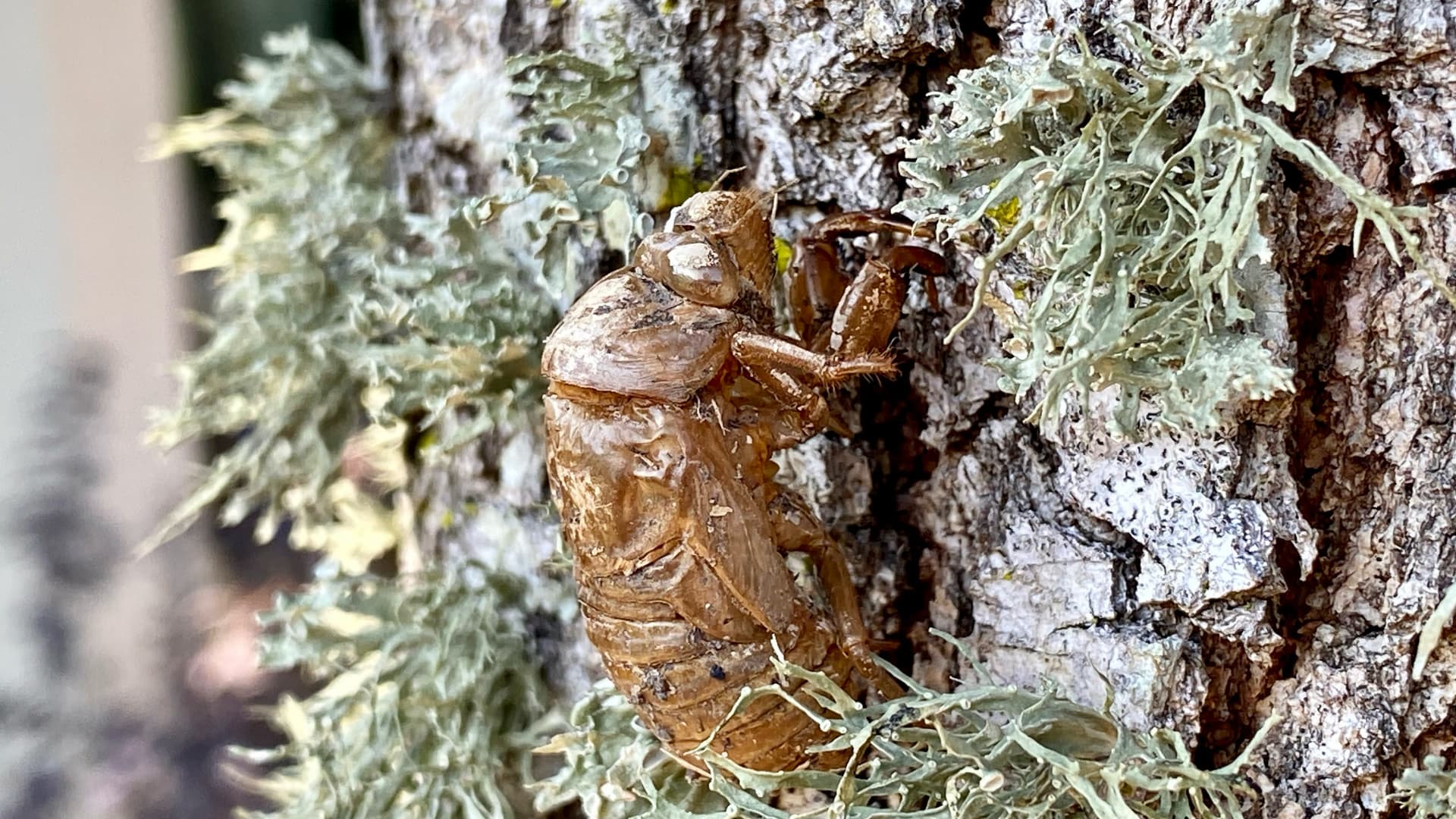
📸 Photo Description
This image shows a cicada's shed exoskeleton (outer skin) clinging to tree bark surrounded by lichen. The brown, paper-like shell is hollow and includes the insect's former head, legs, and body covering. The cicada has already left this shell behind and moved on to live as an adult insect in the tree.
🔬 Scientific Phenomena
Anchoring Phenomenon: A cicada shedding its exoskeleton during metamorphosis
Why This Happens (Scientific Explanation):
Cicadas spend years underground as nymphs (young insects), where they grow larger but stay inside their hard outer skin. Once the nymph is ready to become an adult, it crawls up a tree and molts—splitting its old skin and wiggling out. This process is called ecdysis. The insect leaves behind the hollow shell (called an exuviae) and emerges with a soft, new skin underneath that hardens and darkens. This is a form of incomplete metamorphosis, where the insect gradually transforms from nymph to adult without a dramatic pupal stage like butterflies experience.
📚 Core Science Concepts
- Life Cycles & Growth: Insects like cicadas go through distinct stages of life. Unlike humans, they must shed their skin to grow because their outer skeleton (exoskeleton) doesn't stretch.
- Metamorphosis: Cicadas undergo incomplete metamorphosis, changing from a smaller, underground-dwelling nymph into a larger adult with wings and the ability to sing and reproduce.
- Structural Adaptations: The hard exoskeleton protects the insect's body, but eventually it becomes too small, requiring the insect to shed it and grow a new one.
- Ecosystem Interactions: The shed shell remains on the tree as evidence of an insect's development and becomes part of the forest ecosystem where it may be used by small creatures or decomposed by microorganisms.
Pedagogical Tip:
When teaching this concept, consider bringing a live cicada shell (exuviae) to class in a sealed container so students can observe the detailed structure with magnifying glasses. This tangible experience is far more memorable than pictures alone. Have students sketch what they observe, labeling the head, legs, and body segments. This builds observational drawing skills while deepening understanding of insect anatomy.
UDL Suggestions:
Multiple Means of Representation: Provide the lesson in visual (images like this), kinesthetic (students act out molting), and verbal (teacher explanation) formats. Use a life cycle diagram with arrows showing the progression from egg → nymph (underground years) → nymph climbing tree → molting → adult.
Multiple Means of Engagement: Allow students to choose how they demonstrate learning—drawing the life cycle, building a model with craft materials, or recording a short video explanation. This honors diverse learning preferences and interests.
Multiple Means of Expression: Offer sentence frames for written responses (e.g., "The cicada shed its skin because ____.") and allow verbal responses for students who struggle with writing.
🎓 NGSS Connections
Performance Expectation:
3-LS1-1: Develop models to describe that organisms have unique and diverse life cycles but all animals have in common birth, growth, reproduction, and death.
Disciplinary Core Ideas:
- : Growth and Development of Organisms
- : Interdependent Relationships in Ecosystems (shed shells as part of ecosystem)
Crosscutting Concepts:
- : Life cycles follow recognizable patterns across different animal species
- : The exoskeleton's structure allows it to protect but must be shed to allow growth
💬 Discussion Questions
- Why do you think the cicada had to leave its old skin behind? What would happen if it tried to stay in the same shell? (Bloom's: Understand | DOK: 2)
- Compare the cicada's life cycle to your own growth. How are they the same? How are they different? (Bloom's: Analyze | DOK: 2)
- What do you think happens to this empty shell after the cicada leaves? Where does it go? (Bloom's: Evaluate | DOK: 3)
- If you found ten of these shells on different trees during the summer, what could you infer about how many cicadas live in that area? (Bloom's: Analyze | DOK: 3)
📖 Vocabulary
- Exoskeleton: A hard, protective outer covering that insects wear on the outside of their bodies instead of bones inside like humans have.
- Molt (or Molting): When an animal sheds or gets rid of its old outer skin or shell so it can grow bigger.
- Nymph: A young insect that looks a little like the adult but is smaller and sometimes lives in a different place (like underground for cicadas).
- Metamorphosis: A big change in how an animal looks and where it lives as it grows from baby to adult.
- Exuviae: The name for the empty shell or skin that an insect leaves behind after it molts (you can say "exu-VY-ee").
- Lichen: Tiny living things that grow on rocks and tree bark; they look fuzzy or crusty and often have green, gray, or orange colors.
🌡️ Extension Activities
- Cicada Life Cycle Model: Provide students with clay, craft supplies, or a paper-folding template to create a 4-stage life cycle model (egg, nymph in soil, nymph on tree, adult). Students can photograph or draw each stage and arrange them in order, then present to a partner.
- Molting Simulation: Have students create a "body outline" on craft paper and cover it with tape (exoskeleton). Challenge them to carefully remove the tape without tearing it, representing the molting process. Discuss why it needs to be gentle and what happens to the insect's skin during this time.
- Shed Shell Investigation: If available, take students on a short nature walk around the school to search for cicada shells on trees, logs, or buildings. Collect shells carefully and observe them with magnifying glasses, recording observations in a science journal. Create a class chart showing where shells were found and why cicadas might choose those locations.
🔍 Zoom In / Zoom Out Concepts
Zoom In: Cellular Level
Beneath the cicada's exoskeleton is a thin layer of skin cells that produce a completely new, larger exoskeleton underneath the old one. Before the cicada molts, special cells are working hard inside the insect's body, building and hardening this brand-new skin. The old exoskeleton is made of a material called chitin (KITE-in), which is stronger than plastic but can't stretch like human skin. When the new exoskeleton is ready, the cicada's body produces special "softening juices" that help loosen the old shell from the new one underneath, making it easier to wiggle out.
Zoom Out: Forest Ecosystem
The cicada's shed shell becomes part of a larger forest community. Decomposer organisms—tiny bacteria, fungi, and insects—begin breaking down the abandoned exoskeleton, turning it back into nutrients that feed the soil and help plants grow. Other small creatures, like tiny beetles or spiders, may use the hollow shell as shelter or a hunting ground. The lichen growing on the tree bark nearby depends on moisture and nutrients in the air, and the cicada's presence (including its molting cycle) contributes to the overall health and activity of the ecosystem. All these organisms—cicadas, lichen, decomposers, and plants—are connected in an invisible web of life.
🤔 Potential Student Misconceptions
Misconception 1: "The cicada died and left its body on the tree."
Clarification: The cicada didn't die—it's still alive and living in the tree! What we see is only the skin or outer covering the cicada left behind, like taking off an old jacket. The real cicada is now a grown-up insect living in the branches above, where it sings and finds food.
Misconception 2: "Cicadas molt once, and then they're done growing."
Clarification: Actually, cicada nymphs molt many times—sometimes 4 to 5 times or more—while they're living underground for several years. Each time they outgrow their skin, they shed it and grow a new one. The molt we see on the tree is the last molt, when the nymph becomes an adult and leaves the ground for good.
Misconception 3: "All insects shed their skin like cicadas do."
Clarification: Many insects do molt, but not all! Butterflies and moths go through a different kind of change called metamorphosis—they make a hard shell called a chrysalis and transform completely inside it. Beetles, grasshoppers, and dragonflies molt like cicadas, but insects change in different ways depending on what kind they are.
🔗 Cross-Curricular Ideas
ELA Connection: Narrative Writing
Have students write a short story from the cicada's perspective, telling the tale of its journey from underground nymph to tree-climbing molter to singing adult. Provide a story frame: "I spent ___ years underground. When I was ready to grow up, I climbed a tree and _____. Now I am _____." Students can illustrate their stories to create a cicada autobiography book.
Math Connection: Life Cycle Timeline
Cicadas can spend 2 to 17 years underground as nymphs! Create a visual timeline on the classroom floor or wall using string and cards. Have students place numbers showing different cicada life spans, then ask comparison questions: "How many MORE years does a 17-year cicada spend underground than a 2-year cicada?" or "If a cicada molted 5 times before becoming an adult, and it was underground for 13 years, about how many years passed between each molt?" This builds subtraction and division skills while reinforcing the cicada concept.
Art Connection: Natural Sculpture & Observation Drawing
Provide students with the cicada shell image (or a real shell if available) and have them create detailed observational drawings using colored pencils, focusing on texture, shape, and the lichen surrounding it. Then, students can create a three-dimensional nature sculpture using found materials (twigs, leaves, bark, craft paper) to represent a tree with a molting cicada, combining art with scientific accuracy.
Social Studies Connection: Local Naturalist Study
Connect to community and nature stewardship by researching a local naturalist, entomologist, or park ranger who studies insects in your region. Invite them to visit the classroom to discuss cicadas and other local insects, or have students create "Thank You" posters for people who protect nature and help us understand wildlife. This builds appreciation for science careers and environmental responsibility.
🚀 STEM Career Connection
- Entomologist — Studies insects — how they live, what they eat, and the jobs they do in an ecosystem.
- Try it: Explain how a cicada's exoskeleton helps it survive by comparing it to a suit of armor. (Practice: Constructing Explanations and Designing Solutions)
- Tools: insect nets, a hand lens, pinning boards, microscopes
- Where they work: museums, farms, insect labs, universities
- Meet one: Corrie Moreau — How ants evolved together with the bacteria that live inside them.
- Median pay: /year — "Zoologists and wildlife biologists"
- Biologist — Studies living things of every kind and what keeps them alive.
- Try it: Design a simple experiment to test how different temperatures affect the hardening of a cicada's new exoskeleton. (Practice: Constructing Explanations and Designing Solutions)
- Tools: microscopes, sample jars, measuring tools, a field notebook
- Where they work: laboratories, field sites, museums, universities
- Meet one: Sandra Díaz — What a plant's leaves, wood and shape tell you about how it lives — and how those traits add up across a whole ecosystem.
- Median pay: /year — "Biological scientists, all other"
- Materials Scientist — Invents and tests new materials — stronger, lighter, or able to do something the old ones could not.
- Try it: Think about what makes a cicada's exoskeleton strong but flexible, and suggest a man-made material that has similar properties. (Practice: Constructing Explanations and Designing Solutions)
- Tools: electron microscopes, stress testers, furnaces, X-ray diffractometers
- Where they work: research laboratories, manufacturing companies, national labs, universities
- Meet one: Ainissa Ramirez — How to make metal stick to glass and ceramics — she invented a solder that does it.
- Median pay: /year — "Materials scientists"
Wage figures are median annual wages for the U.S. occupation named after each one, from the U.S. Bureau of Labor Statistics, Occupational Employment and Wage Statistics (OEWS), national, May 2025. Several careers share one occupation, so their figures match.
---
Teacher Note: This phenomenon is excellent for spring or early summer outdoor observation. Pair this lesson with actual cicada listening if your region has cicadas—the connection between the visual evidence (shed skin) and the auditory experience (cicada songs) creates a multi-sensory learning moment that Third Graders find deeply engaging.