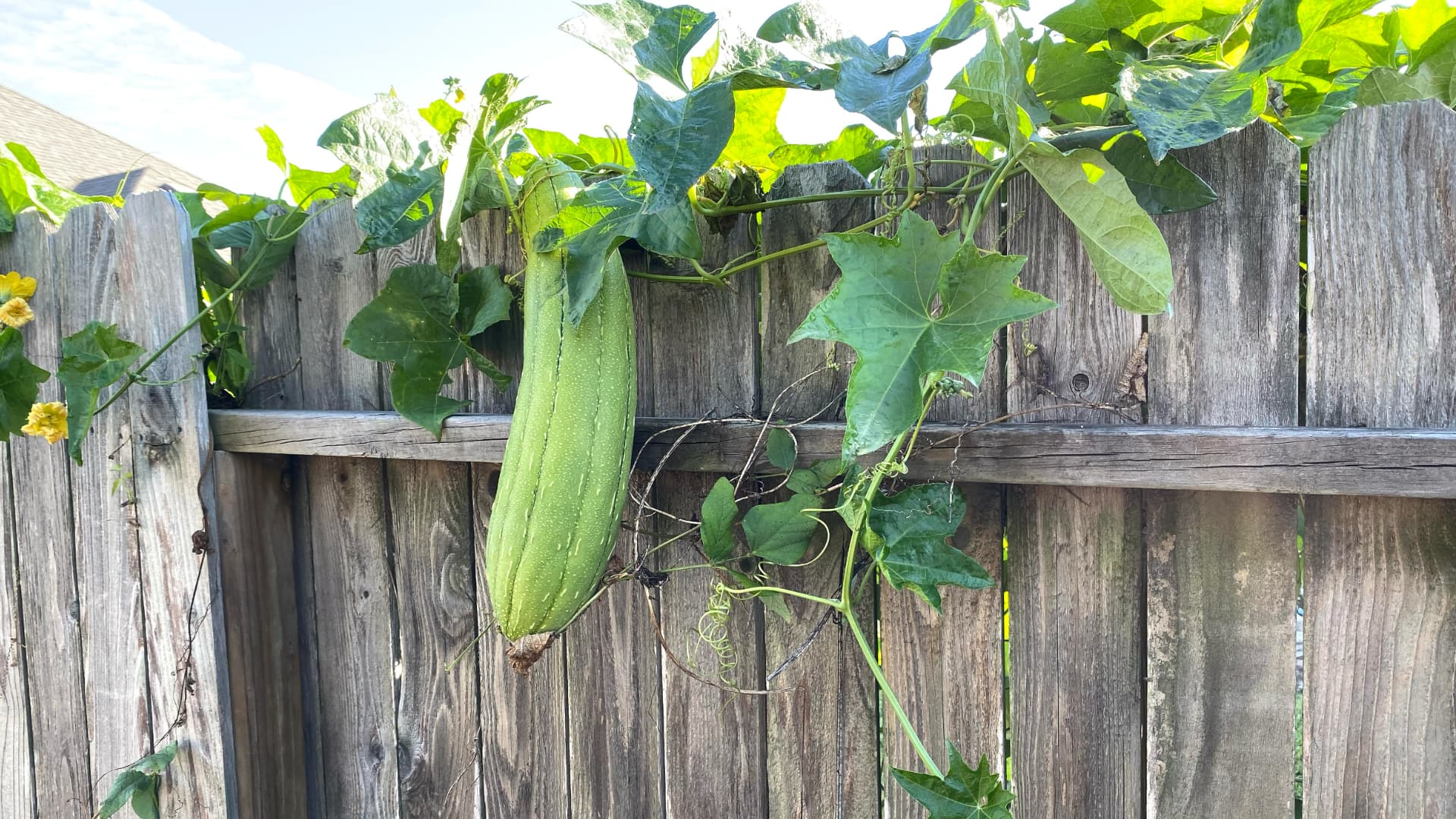
📸 Photo Description
This image shows a long, green bean pod hanging from a climbing vine with large leaves. The vine is growing up and over a wooden fence. The plant has curly tendrils that help it climb, and you can see bright green leaves catching the sunlight. This is a plant that grows by wrapping around structures to reach toward the sun.
🔬 Scientific Phenomena
Anchoring Phenomenon: Why do some plants climb instead of grow straight up?
Plants like beans develop special adaptations called tendrils and vining growth patterns to climb toward sunlight with less energy than building thick, sturdy stems. This climbing behavior allows the plant to access more sunlight in crowded spaces (like a garden) without needing to support its own weight with a thick stem. The plant's growth is directed by environmental cues—primarily light and gravity—which trigger the tendrils to wrap around nearby structures. This is an example of how organisms respond to their environment to survive and grow.
📚 Core Science Concepts
- Plant Structures and Functions: Vines, tendrils, and leaves each have specific jobs. Tendrils grip and climb; leaves capture sunlight; pods hold seeds for making new plants.
- Growth and Life Cycles: Plants grow through different stages. Bean plants start as seeds, grow vines and leaves, produce flowers, and make pods with new seeds inside.
- Environmental Response: Plants respond to their surroundings. This vine grows toward the light and wraps around the fence because these actions help it survive and thrive.
- Interdependence: The vine depends on the fence for support, and the plant provides food and shelter for insects and animals that might visit it.
Pedagogical Tip:
For Kindergarteners, use tactile exploration whenever possible. Let students touch real bean pods, tendrils, and leaves (if safely available) before discussing them. Kinesthetic learners retain more when they can physically interact with the phenomenon. Consider growing beans in your classroom so students can observe growth changes over days and weeks—this concrete experience is far more powerful than pictures alone.
UDL Suggestions:
Representation: Provide multiple ways to experience this content: actual plants in the classroom, large photographs at various distances, videos of time-lapse growth, and tactile models. Some students may benefit from magnifying glasses to examine tendrils more closely. Action & Expression: Allow students to demonstrate understanding through drawing, dramatic play (pretending to be a climbing vine), building with blocks, or arranging materials to show how a vine climbs. Engagement: Connect the vine to students' lives by showing vines in their neighborhood, discussing foods they eat that come from vining plants (grapes, beans, peas), and celebrating what makes this plant "clever" or "special."
🔍 Zoom In / Zoom Out Concepts
Zoom In — Cellular Level:
Inside the bean pod are hundreds of tiny plant cells working together. Each cell is like a small room with walls made of cellulose. These cells are packed tightly and filled with water, which keeps the pod firm and helps it grow. At an even tinier level, chlorophyll in the leaf cells captures light energy and turns it into food for the plant. The plant has special vascular cells (like tiny tubes) that carry water from the roots up through the tendrils and leaves.
Zoom Out — Garden Ecosystem:
This climbing bean plant is part of a larger garden system. Its flowers attract bees and butterflies, which pollinate the plant and help it make beans. The roots below ground break down soil, improve it, and take in water that rain provides. When the beans fall or decompose, they return nutrients to the soil. Birds, insects, and small animals may eat the plants or shelter in them. Humans harvest the beans for food. The entire fence-garden system shows how living (plants, insects, animals, people) and non-living (soil, water, fence, sunlight) things work together.
🤔 Potential Student Misconceptions
- Misconception: "Plants eat dirt like we eat food."
- Clarification: Plants don't eat soil. They take tiny bits of nutrients and water from soil through their roots. Plants make their own food using sunlight, air, and water. This food-making happens in the leaves.
- Misconception: "The vine is wrapping around the fence because someone taught it to do that, or it's trying to hide."
- Clarification: The vine wraps around the fence because of how it grows naturally. Scientists call this behavior tropism. The vine grows toward light and wraps around anything it touches. It's not thinking or learning—it's just how the plant's body works, like how your body automatically blinks to protect your eyes.
- Misconception: "Only beans are food. That green pod isn't food because it's still growing on the plant."
- Clarification: The bean pod IS food! We can eat beans and pods while they're still on the plant. When beans are young and tender, people eat the whole pod (called "snap beans" or "green beans"). As they grow older, we can harvest them dry and store them. The same plant gives us food at different stages of growth.
🎓 NGSS Connections
Performance Expectation (undefined-K level):
Students who demonstrate understanding can observe and describe how plants and animals have different structures that support survival, growth, and behavior in different environments.
Disciplinary Core Ideas:
- — Structure and Function: Plants have roots, stems, and leaves that help them grow and survive.
- — Growth and Development: Living things grow and change over time.
- — Interdependent Relationships in Ecosystems: Plants need light, water, and soil nutrients. Animals depend on plants for food and shelter.
Crosscutting Concepts:
- — The tendrils and vine structure serve the function of climbing and capturing light.
- — Because the plant grows toward light and touches the fence, the vine wraps around it.
- — Plants show patterns in growth: seed → sprout → leaves → flowers → fruit.
💬 Discussion Questions
- "What do you think this vine is trying to do by wrapping around the fence?" (Bloom's: Understand | DOK: 1)
- "Why might it be helpful for a plant to climb instead of growing straight up?" (Bloom's: Analyze | DOK: 2)
- "If we removed the fence, how might this plant grow differently? What would happen?" (Bloom's: Evaluate | DOK: 3)
- "What other things in nature or our classroom could a vine wrap around? Why?" (Bloom's: Apply | DOK: 2)
📖 Vocabulary
- Vine: A plant with long, thin stems that climb or spread along the ground.
- Tendril: A thin, curly part of a vine that wraps around things to help the plant climb.
- Pod: The case or container that holds seeds, like a green bean pod.
- Grow: To get bigger and develop over time.
- Climb: To move upward, using something for support.
🌡️ Extension Activities
- Grow Your Own Beans: Plant bean seeds in clear cups or containers so students can see the roots growing down and the shoots growing up. Over 1–2 weeks, observe how the vine grows, wraps around a stick or string support, and develops leaves. Students can draw or paint what they observe each day. This provides direct, concrete experience with plant growth and structure.
- Tactile Tendril Exploration: Provide real or craft-made tendrils, curling ribbons, and climbing toys. Let students manipulate them, wrap them around objects (pencils, blocks, fence sections), and explore how curling helps things grip and hold on. Discuss why tendrils curl and how this shape is "smart" for climbing.
- Garden Hunt Walk: Take students on a nature walk around your school or neighborhood to find other climbing plants (ivy, morning glories, climbing roses, real vines). Sketch or photograph them. Return to the classroom and create a class chart showing "Plants That Climb" vs. "Plants That Grow Straight." Discuss what's the same and different about their structures.
🔗 Cross-Curricular Ideas
- ELA — Story Telling & Literature: Read plant-themed picture books like The Tiny Seed by Eric Carle or Up in the Garden and Down in the Dirt by Kate Messner. Act out the life cycle of a bean plant using drama and movement, with students becoming seeds, sprouts, leaves, flowers, and pods.
- Math — Measurement & Patterns: Measure how many inches or centimeters the vine grows each week. Create a simple line graph showing growth over time. Count the number of leaves, tendrils, or pods. Sort beans by size or color. Look for patterns in how leaves and tendrils are arranged on the stem.
- Art — Observational Drawing & Nature Collage: Students draw or paint the vine and fence from observation, focusing on shapes, colors, and textures. Create a collage using actual leaves, pressed flowers, or colored paper to represent the plant's growth. Make prints using bean pods and leaves with paint or ink.
- Social Studies — Community & Food: Discuss where our food comes from. Explore the connection between the farmer, the garden, and our food. If possible, visit a local farm or farmer's market to see real crops. Create a classroom chart of foods that grow on vines (grapes, beans, cucumbers, pumpkins, peas). Talk about jobs related to growing and selling food.
🚀 STEM Career Connection
- Horticulturist — Grows and cares for plants on purpose — choosing what will thrive in a particular place.
- Try it: Design a simple experiment to test if a vine grows better when it has something to climb on. (Practice: Constructing Explanations and Designing Solutions)
- Tools: pruning shears, soil test kits, grafting knives, greenhouses
- Where they work: botanical gardens, plant nurseries, city parks, farms and orchards
- Meet one: Carlos Magdalena — How to bring the world's rarest plants back from the edge, including the smallest water lily on Earth after it vanished from the wild.
- Median pay: /year — "Soil and plant scientists"
- Biologist — Studies living things of every kind and what keeps them alive.
- Try it: Explain why vines need to climb to survive, using evidence from the lesson about sunlight and support. (Practice: Constructing Explanations and Designing Solutions)
- Tools: microscopes, sample jars, measuring tools, a field notebook
- Where they work: laboratories, field sites, museums, universities
- Meet one: Sandra Díaz — What a plant's leaves, wood and shape tell you about how it lives — and how those traits add up across a whole ecosystem.
- Median pay: /year — "Biological scientists, all other"
Wage figures are median annual wages for the U.S. occupation named after each one, from the U.S. Bureau of Labor Statistics, Occupational Employment and Wage Statistics (OEWS), national, May 2025. Several careers share one occupation, so their figures match.