📸 Photo Description
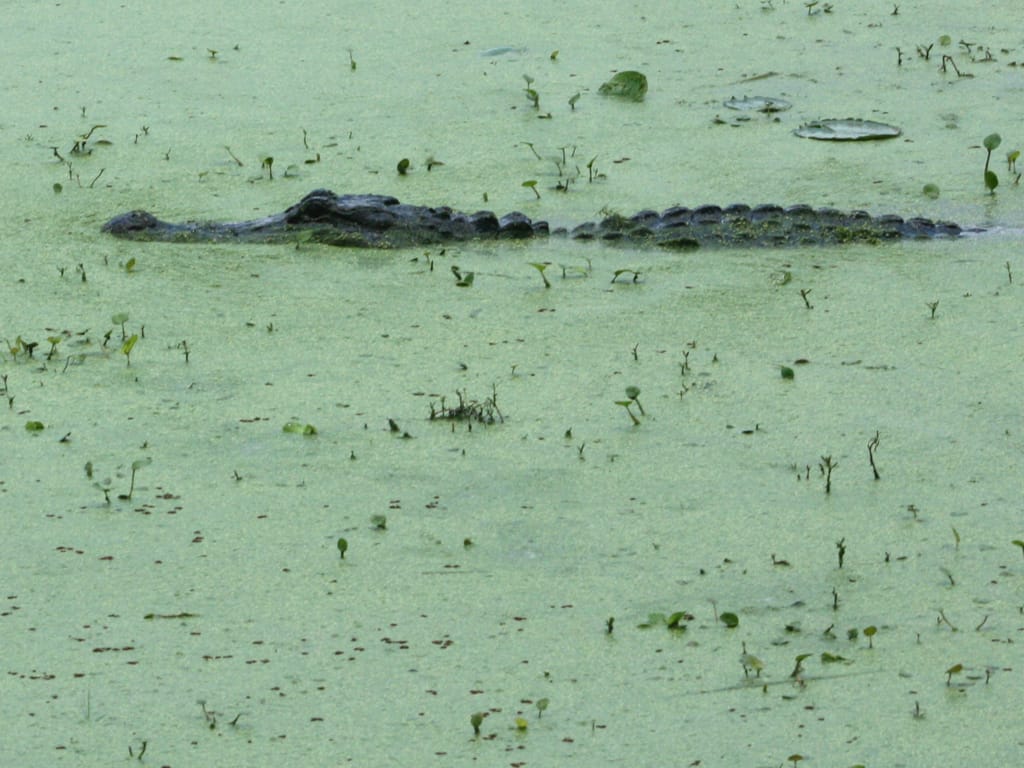
The photo shows an alligator swimming in murky, green water covered with small plants. The alligator's body is mostly submerged, with only its head and back visible. This scene depicts a predator in its natural habitat, an environment full of life.
🔬 Scientific Phenomena
This image represents the phenomenon of predator-prey relationships within a specific habitat. The alligator, as a predator, relies on its environment and the presence of prey for survival. The murky, vegetated water provides camouflage for the alligator, allowing it to hunt effectively. This habitat also supports the plants and smaller organisms that the alligator may eat.
📚 Core Science Concepts
- Habitats: An environment where a plant or animal lives, providing food, water, shelter, and space. This wetland is a habitat for the alligator.
- Predator and Prey: Predators hunt and eat other animals (prey). Alligators are predators that eat fish, birds, and other animals.
- Adaptations for Survival: Organisms have specific features or behaviors that help them survive in their environment. The alligator's camouflage and swimming ability are adaptations.
Pedagogical Tip: When discussing adaptations, encourage students to think about both physical traits (like camouflage) and behaviors (like lurking in the water).
- Interdependence: Organisms in an ecosystem rely on each other. The alligator depends on the prey in its habitat, and the plants and animals it eats depend on the ecosystem for their own survival.
UDL Suggestions: Provide visual aids such as diagrams of food webs or predator-prey interactions to support students with varying learning needs. For students who benefit from auditory input, consider reading aloud descriptions of alligator habitats and behaviors.
🔍 Zoom In / Zoom Out Concepts
- Zoom In: At a microscopic level, the green color of the water might be due to algae or other microorganisms. These tiny organisms form the base of a food web, providing food for smaller animals that eventually become prey for larger animals like the alligator.
- Zoom Out: This wetland ecosystem is part of a larger watershed. The health of this wetland, and the alligator population within it, is connected to the quality and quantity of water flowing into it from surrounding areas, as well as how the water flows out.
🤔 Potential Student Misconceptions
- Misconception: Alligators are just "big lizards" and don't have special needs.
Clarification: Alligators are reptiles, but they have specific needs related to their aquatic habitat, including water for swimming, hunting, and regulating their body temperature.
- Misconception: Animals only eat other animals.
Clarification: While this image shows a predator, many animals also eat plants. The alligator's diet can include fish, birds, and small mammals, but the overall ecosystem also contains plants that support these animals.
🎓 NGSS Connections
3-LS4-3: Construct an argument with evidence that in a particular habitat some organisms can survive well, some survive less well, and some cannot survive at all.
2-LS4-1 (Grade 2 — foundational connection): Make observations of plants and animals to compare the diversity of life in different habitats.
💬 Discussion Questions
- What makes this watery place a good home, or habitat, for an alligator? (Bloom's: Understand | DOK: 2 | SEP: Constructing Explanations and Designing Solutions)
- How does the alligator's appearance help it survive in this environment? (Bloom's: Analyze | DOK: 2 | SEP: Constructing Explanations and Designing Solutions)
- What might happen to the alligator if there were no fish or other animals in this water? (Bloom's: Analyze | DOK: 2 | SEP: Analyzing and Interpreting Data)
📖 Vocabulary
- Habitat: The natural home or environment of an animal, plant, or other organism.
- Predator: An animal that hunts other animals for food.
- Prey: An animal that is hunted and killed by another animal for food.
- Adaptation: A special feature or behavior that helps an organism survive in its environment.
- Ecosystem: All the living things (plants, animals, and organisms) in a specific area, along with their non-living environment (air, water, and soil).
🌡️ Extension Activities
- Habitat Diorama: Have students create a diorama of a wetland habitat, including an alligator and other animals or plants that might live there. They can label the different parts of the habitat.
- Predator vs. Prey Sort: Provide pictures of various animals and have students sort them into categories of predators and prey, discussing what each animal eats and what eats it.
- Adaptation Charades: Write down different animal adaptations (e.g., camouflage, sharp teeth, long neck, webbed feet) on slips of paper. Students pick a slip and act out the adaptation for others to guess.
🔗 Cross-Curricular Ideas
- ELA: Read books about alligators and wetlands. Students can write a short story from the perspective of an alligator living in its habitat.
- Art: Students can draw or paint the alligator in its wetland environment, focusing on the colors and textures of the water and plants.
- Social Studies: Discuss how humans can impact wetland habitats and what people can do to protect them.
🚀 STEM Career Connection
- Wetland Ecologist — Studies marshes, swamps and bogs — places that are neither quite land nor quite water.
- Try it: Draw a diagram of a wetland habitat and label the parts that provide shelter and food for an alligator. (Practice: Constructing Explanations and Designing Solutions)
- Tools: waders, water level gauges, sediment corers, plant keys
- Where they work: marshes and swamps, water agencies, conservation groups, universities
- Meet one: Sandra Díaz — What a plant's leaves, wood and shape tell you about how it lives — and how those traits add up across a whole ecosystem.
- Median pay: /year — "Environmental scientists and specialists, including health"
- Herpetologist — Studies reptiles and amphibians — snakes, lizards, frogs and turtles.
- Try it: Research and list three adaptations an alligator has for living in water and three for living on land. (Practice: Constructing Explanations and Designing Solutions)
- Tools: snake hooks, pitfall traps, temperature probes, a field notebook
- Where they work: deserts and wetlands, zoos, natural history museums, universities
- Meet one: Earyn McGee — What happens to desert lizards when the streams they live near dry up.
- Median pay: /year — "Zoologists and wildlife biologists"
Wage figures are median annual wages for the U.S. occupation named after each one, from the U.S. Bureau of Labor Statistics, Occupational Employment and Wage Statistics (OEWS), national, May 2025. Several careers share one occupation, so their figures match.