📸 Photo Description
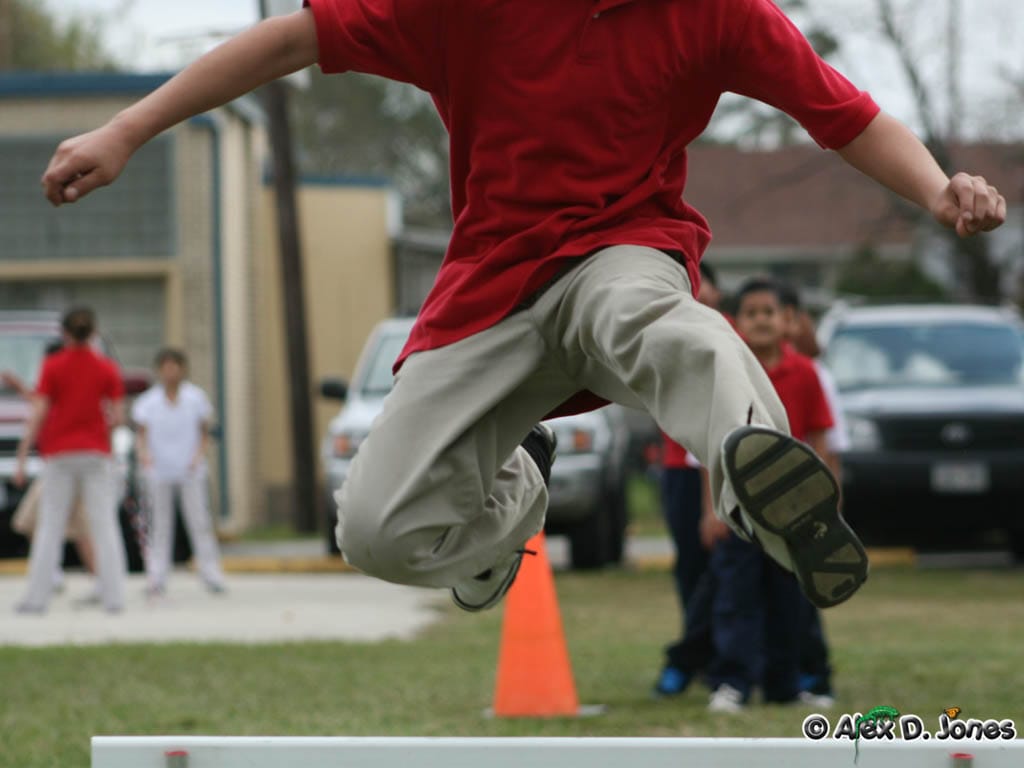
A student wearing a red shirt and gray pants is jumping over an orange cone during an outdoor activity. The child's body is in mid-air, showing their legs bent and arms out to the sides for balance. Other students can be seen in the background watching the activity take place on a grassy area near a school building.
🔬 Scientific Phenomena
Anchoring Phenomenon: A person jumping into the air and landing back on the ground.
Why It's Happening: When the student pushes down hard with their legs against the ground, that force pushes them upward into the air. Gravity is a force that pulls everything toward Earth, so once the student leaves the ground, gravity pulls them back down. The student must use muscular force to overcome gravity to jump, and then gravity brings them safely back to the ground. This is a perfect example of how forces cause changes in motion.
📚 Core Science Concepts
- Force: A push or pull that can make something move, stop, or change direction. In this image, the student's legs push down (force) to make their body go up.
- Motion: A change in position or location. The student is moving upward through the air, then downward back to the ground.
- Gravity: A force that pulls objects toward Earth. It is always working, even when we can't see it, pulling the student back down to the ground after jumping.
- Balance and Control: The student's arms are spread out to help them balance in the air and land safely. This shows how our bodies use forces to control movement.
Pedagogical Tip:
Help students understand that forces are all around them by using their own bodies as examples. Have them feel the push of the ground under their feet when jumping, or the pull of gravity when they fall. Concrete, experiential learning is crucial for third graders to grasp abstract concepts like force and gravity.
UDL Suggestions:
To support diverse learners, provide multiple means of engagement and representation: (1) Allow kinesthetic learners to physically jump and describe what they feel; (2) Use visual aids like arrows drawn on photos to show direction of forces; (3) Offer vocabulary cards with pictures for students who benefit from visual scaffolding; (4) Partner students who need support with peer models during hands-on activities.
🎓 NGSS Connections
Performance Expectation: 3-PS2-1: Plan and conduct an investigation to provide evidence that balanced and unbalanced forces on an object change its motion.
Disciplinary Core Ideas:
- (Forces and Motion)
- (Types of Interactions)
Crosscutting Concepts:
-
-
💬 Discussion Questions
- What force did the student use to jump into the air? (Bloom's: Understand | DOK: 1)
- Why does the student come back down to the ground after jumping? What force makes that happen? (Bloom's: Explain | DOK: 2)
- How did the student use their arms to help with their jump? What would happen if they kept their arms at their sides? (Bloom's: Analyze | DOK: 2)
- If you jumped on the Moon instead of Earth, where gravity is much weaker, how do you think your jump would be different? (Bloom's: Evaluate | DOK: 3)
📖 Vocabulary
- Force: A push or pull that makes something move or changes how it is moving.
- Gravity: An invisible force that pulls everything toward Earth.
- Motion: When something changes position and moves from one place to another.
- Jump: To push off the ground with your legs to go into the air.
- Balance: Keeping your body steady and not falling over.
🌡️ Extension Activities
- Jump Challenge: Set up a safe obstacle course with cones of different heights. Have students practice jumping over cones and record how high they can jump. Discuss what forces helped them jump higher (more leg push) and what made it harder (obstacles in the way).
- Force Detective Walk: Take students on a "force hunt" around the playground or classroom. Have them identify and record examples of pushes and pulls they see (pushing a swing, pulling a door, jumping off a step). Create a class chart showing "Push Forces" and "Pull Forces."
- Gravity Experiment: Drop different objects from the same height (ball, feather, paper, apple) and observe which falls fastest. Discuss whether gravity pulls all objects equally. Then crumple the paper and drop it again to show how air resistance affects falling objects.
🔍 Zoom In / Zoom Out Concepts
Zoom In: When the student's muscles contract (get shorter and tighter), tiny fibers inside the muscles are sliding past each other. These muscle fibers are made of even smaller parts called proteins that work together like a team pulling on each other. When millions of these tiny protein fibers work together, they create the big force needed to push the student's legs down and launch their body into the air. Without these microscopic muscle fibers contracting all at once, the student wouldn't be able to jump!
Zoom Out: This jumping activity is part of a larger school fitness and wellness system. Physical education programs help build strong communities where students develop healthy habits. When students participate in jumping games and obstacle courses, they're part of a bigger pattern of movement and exercise that happens in schools across the world. This promotes healthy bodies and minds in children everywhere, and helps create communities where people stay active and strong throughout their lives.
🤔 Potential Student Misconceptions
Misconception 1: "I have to jump to make gravity stop working on me."
- Scientific Clarification: Gravity is always pulling on us, even when we're jumping! When you jump, you're not escaping gravity—you're only in the air for a moment because gravity keeps pulling you back down. Gravity never stops working; it always pulls everything toward Earth. That's why you come back down after jumping, no matter how high you jump.
Misconception 2: "Bigger/stronger kids jump higher because they're heavier, so they can push harder against the ground."
- Scientific Clarification: While muscle strength does help you jump higher, your weight isn't what makes you jump higher. In fact, if you have stronger leg muscles, you can push down with more force, which makes you go higher. A smaller child with very strong muscles might jump just as high or higher than a bigger child with weaker muscles. It's about the force your muscles can create, not how heavy you are.
Misconception 3: "When I'm in the air, I'm floating because I got away from Earth."
- Scientific Clarification: You're never really floating or away from Earth's gravity when you jump. Gravity is still pulling you down the whole time you're in the air! You're only up there for a split second before gravity brings you back down. Even when astronauts are in space, gravity is still pulling on them—it's just very far away that it feels different.
🔗 Cross-Curricular Ideas
Math Connection: Have students measure and compare jump heights using a measuring tape or meter stick. Create a class data chart showing which students jumped the highest and lowest. Ask questions like: "How much higher did Sarah jump than Marcus?" and "If you add up the three highest jumps, what's the total?" This connects force and motion to measurement and data analysis.
ELA Connection: Ask students to write or dictate descriptive sentences about the jumping activity using action words (verbs). Have them create a short story titled "The Amazing Jump" that explains what happens before, during, and after the jump. Read aloud books about movement and encourage students to act out the jumping motions while listening to the story.
Physical Education/Health Connection: Design a "Forces in Sports" unit where students explore how different sports use pushing and pulling forces. Have them practice jumping in basketball, long jump in track and field, and jumping rope. Discuss how athletes use their understanding of forces to jump higher, run faster, or throw farther. Connect this to healthy exercise habits.
Art Connection: Have students create a "motion drawing" or comic strip showing the four stages of a jump: starting position, pushing off, in the air, and landing. They can draw arrows on their pictures to show the direction of forces (push down, gravity pulling down, movement up). Display these as a classroom gallery to celebrate different ways of showing force and motion through art.
🚀 STEM Career Connection
- Mechanical Engineer — Designs things that move — engines, turbines, joints and gears — and works out the forces on them.
- Try it: Design and build a small vehicle that can roll down a ramp, explaining how different wheel sizes affect its motion. (Practice: Constructing explanations)
- Tools: CAD software, 3D printers, force sensors, wind tunnels
- Where they work: engineering firms, factories, design studios, research labs
- Meet one: Shini Somara — How air and water flow around things, worked out on a computer before anything is built.
- Median pay: /year — "Mechanical engineers"
- Physicist — Works out the rules that matter and energy follow, from the very small to the whole universe.
- Try it: Explore how friction affects motion by sliding different objects across various surfaces and observing the differences. (Practice: Constructing explanations)
- Tools: lasers, detectors, vacuum chambers, computer simulations
- Where they work: research laboratories, particle accelerators, observatories, universities
- Meet one: Chanda Prescod-Weinstein — Dark matter — the invisible material that makes up most of the universe.
- Median pay: /year — "Physicists"
Wage figures are median annual wages for the U.S. occupation named after each one, from the U.S. Bureau of Labor Statistics, Occupational Employment and Wage Statistics (OEWS), national, May 2025. Several careers share one occupation, so their figures match.