📸 Photo Description
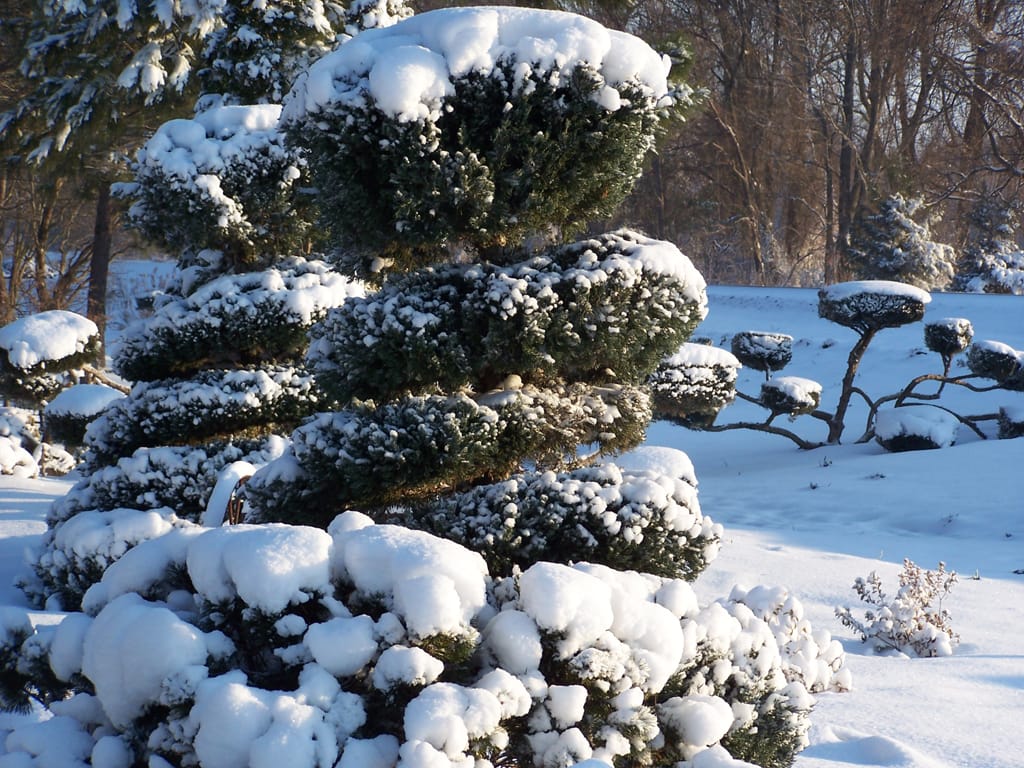
This image shows evergreen trees (like pine and spruce trees) completely covered with thick, fluffy snow during winter. The bright white snow clings to the green branches, and you can see bare deciduous trees in the background. The sunny day makes the snow sparkle and shine brightly against the blue sky and snowy ground.
🔬 Scientific Phenomena
Anchoring Phenomenon: Why do evergreen trees get covered with heavy snow while deciduous trees lose their leaves?
Scientific Explanation: During winter, water vapor in the air freezes into snow crystals when temperatures drop below freezing (32°F or 0°C). Evergreen trees keep their needle-like leaves year-round, giving snow many surfaces to accumulate on. The snow sticks to these branches and builds up into thick, heavy layers. Deciduous trees (shown bare in the background) have already dropped their leaves to conserve water and energy during the cold season, so they have fewer surfaces for snow to collect on. This visible difference helps us observe how different plants adapt to winter conditions.
📚 Core Science Concepts
- States of Water: Water exists in three states—solid (ice/snow), liquid (water), and gas (water vapor). In this image, we see water as snow (solid) and can infer the water vapor that froze to create it.
- Seasonal Changes: Winter is a season characterized by cold temperatures, snow, and shorter days. Trees and plants respond differently to winter conditions based on their species.
- Plant Adaptations: Evergreen trees keep their leaves year-round as an adaptation to winter, while deciduous trees shed their leaves to survive harsh winter conditions with less water loss.
- Weather and Snow Formation: Snow forms when water vapor in clouds freezes into ice crystals high in the atmosphere, then falls to the ground when it becomes heavy enough.
Pedagogical Tip:
When teaching about snow formation, help students make the connection between what they observe (snow on trees) and the invisible process (water freezing in clouds). Use the phrase "frozen water vapor" repeatedly so students understand snow is not just "cold water" but water that has changed states.
UDL Suggestions:
Representation: Provide images comparing evergreen vs. deciduous trees side-by-side. Use video of snow falling or melting to show the water cycle in action. Engagement: Allow students to touch real evergreen branches and compare needle texture to deciduous twigs. Action & Expression: Let students sketch the two tree types or create a physical model using pipe cleaners (evergreen) vs. bare sticks (deciduous) and sprinkle artificial snow on both to compare accumulation.
🎓 NGSS Connections
Performance Expectation: 3-ESS2-1: Represent data in tables and graphical displays to describe typical weather conditions expected during a particular season.
Disciplinary Core Ideas:
- - Weather and climate (seasonal patterns and how living things respond)
- - Structure and function (how different plants have different structures suited to their environment)
Crosscutting Concepts:
- - Seasonal patterns of weather and plant behavior
- - How evergreen needles capture snow differently than bare branches
💬 Discussion Questions
- Why do you think evergreen trees keep their leaves in winter when other trees lose theirs? (Bloom's: Evaluate | DOK: 3)
- What do you observe about where the snow is piling up on these trees? Why might that be? (Bloom's: Analyze | DOK: 2)
- If all the snow on this tree melted, where would that water go? (Bloom's: Understand | DOK: 1)
- How might the snow covering these trees help or hurt the plant? (Bloom's: Evaluate | DOK: 3)
📖 Vocabulary
- Evergreen: A tree or plant that keeps its leaves or needles all year long, even during winter.
- Deciduous: A tree that loses all its leaves in the fall to prepare for winter and grows new leaves in spring.
- Snow: Frozen water that falls from clouds in winter when it is cold enough.
- Freeze: To turn from a liquid into a solid by cooling it to very cold temperatures.
- Accumulate: To collect or pile up in larger and larger amounts over time.
- Adaptation: A special feature or behavior that helps a plant or animal survive in its environment.
🌡️ Extension Activities
- Snow Accumulation Experiment: Have students place small evergreen branches and bare twigs in a box of "snow" (shredded white paper or cotton). Shake the box gently and observe which type accumulates more. Record observations in a data table. Discuss why the shapes of the branches matter.
- Seasonal Tree Sorting: Provide pictures of various trees in different seasons. Students sort them into "Evergreen" and "Deciduous" categories and explain their reasoning. Create a class chart showing which trees are visible during each season in your region.
- Winter Weather Tracking: Over 2-3 weeks, have students record daily temperature, precipitation, and cloud cover on a simple weather chart. Create a class graph showing temperature changes and connect observations to the photo (i.e., "We had 2 snowy days like in the picture!").
🔍 Zoom In / Zoom Out Concepts
Zoom In: Microscopic Level
When you look at a snowflake under a microscope, you would see it has a beautiful six-sided crystal shape! Each snowflake forms when water vapor freezes around a tiny speck of dust high in a cold cloud. The water molecules (the smallest parts of water) arrange themselves in special patterns as they freeze. This is why every snowflake has a unique crystal pattern—like nature's fingerprints! Even though we can't see these tiny ice crystals forming with our eyes, billions of them stick together to make the fluffy snow we see piling up on the evergreen branches in this photo.
Zoom Out: Ecosystem & Water Cycle Level
This snowy winter scene is part of a much bigger system called the water cycle that happens all over Earth. Water from oceans, lakes, and rivers evaporates (turns into water vapor) and rises into the atmosphere. When that water vapor cools way up in the clouds, it freezes into snow and falls back to Earth—like in this photo. The snow on these evergreen trees will eventually melt in spring, flowing into streams and rivers that carry it back to larger bodies of water. The trees use some of this melted water to grow new needles in spring. This endless cycle of water moving between the sky, land, and living things happens continuously and is vital to all life on our planet.
🤔 Potential Student Misconceptions
Misconception 1: "Snow is just frozen rain, so rain and snow are basically the same thing."
Scientific Clarification: Snow forms directly from water vapor freezing in the clouds—it doesn't start as rain. When water vapor freezes, it becomes ice crystals that form snowflakes. Rain forms when water droplets in clouds merge and become too heavy to float. Both are frozen or liquid water, but they form differently in the clouds. Think of it this way: snow never goes through a "liquid water" stage in the cloud—it jumps straight from invisible water vapor to solid ice crystals!
Misconception 2: "Evergreen trees keep their leaves all winter because they don't need to rest like other trees."
Scientific Clarification: Evergreen trees DO rest in winter, but they've adapted to survive the cold differently. Their needle-shaped leaves are specially designed to handle freezing temperatures and don't lose as much water in the cold. Deciduous trees drop their leaves to save water and energy because their broad leaves would lose too much moisture in freezing conditions. Both strategies help trees survive winter—they're just different adaptations!
Misconception 3: "The snow makes the tree warmer because it covers it, like a blanket."
Scientific Clarification: While snow can act somewhat like a blanket by trapping air near the branches, the heavy snow load can actually stress the tree by weighing down its branches. The tree doesn't benefit from being covered in snow—it's just something the tree has to survive. Evergreens are built strong enough to handle snow accumulation, but deciduous trees avoid this problem by dropping their leaves first!
🔗 Cross-Curricular Ideas
Math Connection: Create a "Snow Measurement Activity" where students measure the depth of snow on different objects in your schoolyard or in photos (evergreen branches, ground, fence posts, etc.). Record measurements in inches or centimeters and create a bar graph comparing which surfaces accumulated the most snow. Discuss why different shapes and textures collect different amounts of snow. This connects measurement, data collection, and graphing skills to the winter phenomenon.
ELA Connection: Have students write a "Winter Journal Entry from an Evergreen Tree's Perspective." What does the tree "feel" as snow piles up on its branches? What does it "think" about the bare deciduous trees nearby? This creative writing activity helps students develop empathy for organisms and practice descriptive writing while reinforcing concepts about tree adaptations. Students can also read and compare different winter-themed picture books to identify facts versus fantasy about snow and seasons.
Social Studies Connection: Research and discuss "How Different Communities Prepare for Winter Snow." Compare how people in snowy climates (like the location in this photo) prepare their homes, roads, and activities differently than people in warm climates. Create a simple Venn diagram comparing winter activities in your region to winter activities in a very different climate zone. This builds geography and cultural awareness while connecting to real-world applications of seasonal knowledge.
Art Connection: Create a mixed-media winter tree artwork using white tissue paper, cotton balls, or shredded paper to represent snow accumulating on evergreen branches. Students can draw or paint the evergreen tree shape and then layer different white materials to show how snow "sticks" to the needles in clumps. Display these artwork pieces alongside bare branch drawings of deciduous trees to create a visual classroom display showing the contrast. This reinforces the structural differences between tree types while developing fine motor skills and artistic expression.
🚀 STEM Career Connection
- Conservation Scientist — Looks after land, forests and water so they stay healthy for the people and animals who use them.
- Try it: Compare the amount of snow on evergreen and deciduous branches from pictures and discuss why they are different. (Practice: Analyzing and Interpreting Data)
- Tools: soil samplers, aerial photographs, measuring tapes, mapping software
- Where they work: forests and rangelands, parks departments, government agencies, land trusts
- Meet one: Tierra Curry — Which plants and animals are closest to disappearing, and what it takes to save them.
- Median pay: /year — "Conservation scientists"
- Soil Scientist — Studies dirt seriously — what it is made of, what lives in it, and what will grow in it.
- Try it: Examine a small sample of soil and describe its texture and moisture level, thinking about how winter affects it. (Practice: Analyzing and Interpreting Data)
- Tools: soil augers, pH meters, sieve stacks, sample bags
- Where they work: farms and fields, testing laboratories, government agencies, universities
- Meet one: Asmeret Asefaw Berhe — How soil stores carbon, and why that makes dirt part of the climate story.
- Median pay: /year — "Soil and plant scientists"
Wage figures are median annual wages for the U.S. occupation named after each one, from the U.S. Bureau of Labor Statistics, Occupational Employment and Wage Statistics (OEWS), national, May 2025. Several careers share one occupation, so their figures match.