📸 Photo Description
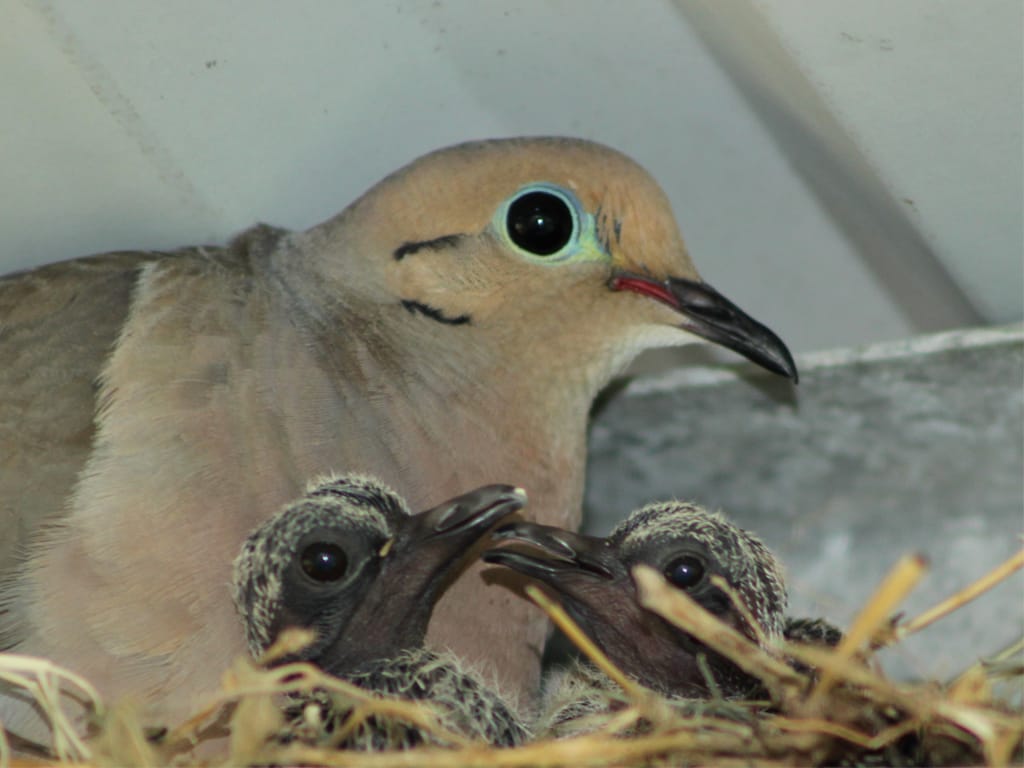
This image shows a parent dove (or similar bird) with two chicks. The parent bird has a tan-colored body with a pale blue eye ring, while the chicks are darker and fluffy. All three birds share similar beak shapes and eye features, showing that babies often look like their parents in important ways.
🔬 Scientific Phenomena
Anchoring Phenomenon: Why do baby birds look similar to their parents?
This image illustrates inherited traits—characteristics that babies receive from their parents through genes. The chicks display similar beak shapes, body structure, and eye placement as the adult bird because genetic information is passed down from parent to offspring. This is a fundamental pattern in nature: living things tend to produce offspring that resemble them. The chicks haven't learned to look this way; they were born with these features because of instructions coded in their DNA inherited from their parent.
📚 Core Science Concepts
- Inherited Traits: Characteristics passed from parents to offspring through genes (such as beak shape, eye color, and body size in these birds)
- Variation Within Species: While the chicks resemble their parent, they are not exact copies—they show slight differences in coloring and size, which is normal in families
- Parent-Offspring Relationships: Baby animals depend on parents for survival, and the family resemblance helps us understand how traits move through generations
- Adaptation to Environment: The beak shape of these birds is suited to their diet and habitat—an inherited trait that helps them survive
Pedagogical Tip:
When teaching inherited traits, use family trees and have students compare photos of themselves with their parents or guardians. This makes the concept personal and relatable. Avoid focusing only on physical appearance; include behaviors and abilities that run in families (like musical talent or athletic skill) to broaden understanding of what "traits" means.
UDL Suggestions:
Provide multiple means of representation by offering both visual examples (photos of animal families) and tactile experiences (sorting cards with inherited trait pictures). Allow students to express learning through drawings, written descriptions, or verbal explanations. Provide sentence frames such as "This chick inherited _____ from its parent because _____" to support all writers.
🎓 NGSS Connections
Performance Expectation: 3-LS3-1
Analyze and interpret data to provide evidence that plants and animals have traits inherited from parents and that variation of these traits exists in a group of similar organisms.
Disciplinary Core Ideas:
- Inheritance of Traits
- Variation of Traits
Crosscutting Concepts:
-
-
💬 Discussion Questions
- What traits does the baby bird share with its parent? (Bloom's: Analyze | DOK: 2)
- Why do you think baby birds look similar to their parents instead of looking like a completely different bird? (Bloom's: Explain | DOK: 3)
- If this parent bird had a different beak shape, what might happen to its babies? (Bloom's: Predict | DOK: 3)
- How are these chicks the same as their parent, and how are they different? (Bloom's: Compare | DOK: 2)
📖 Vocabulary
- Inherited Trait: A characteristic that a baby animal receives from its parents, like eye color or beak shape
- Gene: A tiny instruction inside every living thing that tells our bodies how to grow and what we look like
- Offspring: A baby animal or plant that is born to or produced by parents
- Variation: Small differences between individual animals or plants, even in the same family
- Parent: An adult animal that has babies and passes traits to them
🌡️ Extension Activities
- Family Trait Scavenger Hunt: Students bring in family photos and create a chart showing inherited traits they share with family members (eye color, hair type, smile style). They can sort traits into "physical" and "behavioral" categories.
- Bird Beak Design Challenge: Provide students with different tools (tweezers, clothespins, straws, spoons) to represent different beak shapes. Have them "feed" on different foods (seeds, water, yarn pieces) and discover which beaks work best for different foods. Discuss how inherited beak shape helps birds survive.
- Trait Inheritance Card Game: Create a matching game where students match parent animal cards with offspring cards based on inherited traits. Include unexpected matches to spark discussion about why some traits appear and others don't.
🔍 Zoom In / Zoom Out Concepts
Zoom In: Inside the Cell — DNA and Genes
Even though we can't see genes with our eyes, they are real instructions living inside every cell of the parent bird and chick birds. Imagine genes like a tiny recipe book written in a special code (called DNA) that tells the bird's body how to make its beak, eyes, feathers, and everything else. When a baby bird is made, it gets a copy of some of these recipe pages from its parent, which is why it looks similar. Scientists use special tools called microscopes to see cells, and even more powerful tools to see the DNA inside those cells!
Zoom Out: Population and Species Survival
When we look at many dove families across a whole forest or region, we can see patterns: all the doves in that area share similar traits because they inherited them from their ancestors. This helps the entire dove population survive together. If all doves inherited similar beak shapes suited to eating seeds, they can all find food in their environment. Over many generations, inherited traits that help animals survive become more common in the population—this is how species adapt to their homes and why different bird species look different from each other.
🤔 Potential Student Misconceptions
Misconception 1: "Babies look exactly like their parents."
Clarification: While babies inherit traits from their parents, they are not perfect copies. These chicks look similar to their parent in important ways (like beak shape), but they also have differences in size, exact coloring, and feather patterns. Even in human families, siblings look like their parents but also look different from each other. This variation is normal and healthy!
Misconception 2: "Traits can change during an animal's lifetime and then be passed to babies."
Clarification: Inherited traits are decided before a baby is born and come from the parent's genes. If a parent bird loses feathers or gets a scar, those changes happened after birth and won't be passed to babies. Only the traits that were in the parent's genes from birth can be inherited. This is an important difference between inherited traits (from genes) and acquired traits (learned or gained during life).
Misconception 3: "Animals inherit traits from only one parent."
Clarification: Most baby animals inherit traits from BOTH their mother and father. Each parent contributes genes, so babies show a mix of traits from each parent. That's why you might have your mom's eye color and your dad's hair texture. We can't always tell which parent a trait came from just by looking, but both parents contributed to how the baby looks.
🔗 Cross-Curricular Ideas
ELA Connection — "All About Me" Family Story Books:
Students write and illustrate simple books titled "I Inherited..." where they identify and describe one inherited trait they share with a family member. They can draw themselves and their family member side-by-side, write sentences using the frame "I have _____ like my _____," and create a classroom library of family trait books. This builds descriptive writing while reinforcing the science concept.
Math Connection — Trait Sorting and Data Collection:
Create a classroom survey where students collect data about inherited traits: eye color, hair color, attached or unattached earlobes, tongue-rolling ability, or dimples. Students tally responses on a chart and create bar graphs showing which traits are most common in the class. They can then compare their class data to school-wide data, practicing data organization and comparison skills while exploring variation within their own population.
Social Studies Connection — Exploring Diversity and Family Structures:
Use the image to spark discussions about different family structures (single parents, grandparents raising children, adoptive families, multiple siblings). Help students understand that while inherited traits come from biological parents, all families are valid and loving. Connect to community helpers like doctors and nurses who help all kinds of families stay healthy. This builds cultural competence alongside science understanding.
Art Connection — Mixed-Media Family Portrait Project:
Students create a mixed-media artwork showing themselves and a family member or caregiver, highlighting one inherited trait they share. They might use collage, drawing, paint, or photographs, arranging their faces to show the shared trait (side-by-side eyes, matching smile shapes, similar hand shapes). Display projects alongside labels identifying the inherited trait, creating a classroom gallery celebrating family diversity and biological connections.
🚀 STEM Career Connection
- Biologist — Studies living things of every kind and what keeps them alive.
- Try it: Compare the leaves from two different plants and record their similarities and differences. (Practice: Analyzing and Interpreting Data)
- Tools: microscopes, sample jars, measuring tools, a field notebook
- Where they work: laboratories, field sites, museums, universities
- Meet one: Sandra Díaz — What a plant's leaves, wood and shape tell you about how it lives — and how those traits add up across a whole ecosystem.
- Median pay: /year — "Biological scientists, all other"
- Entomologist — Studies insects — how they live, what they eat, and the jobs they do in an ecosystem.
- Try it: Look for insects outside and draw the different kinds you see, noting their colors and number of legs. (Practice: Analyzing and Interpreting Data)
- Tools: insect nets, a hand lens, pinning boards, microscopes
- Where they work: museums, farms, insect labs, universities
- Meet one: Corrie Moreau — How ants evolved together with the bacteria that live inside them.
- Median pay: /year — "Zoologists and wildlife biologists"
- Ornithologist — Studies birds — how they fly, what they eat, where they nest, and where they travel.
- Try it: Watch birds outside and record the different colors and sizes you observe. (Practice: Analyzing and Interpreting Data)
- Tools: binoculars, spotting scopes, leg bands, sound recorders
- Where they work: wildlife refuges, bird observatories, parks, universities
- Meet one: Corina Newsome — How seaside sparrows in salt marshes lose nests to rising water — nests built higher escape the flooding but become easier for predators to find.
- Median pay: /year — "Zoologists and wildlife biologists"
Wage figures are median annual wages for the U.S. occupation named after each one, from the U.S. Bureau of Labor Statistics, Occupational Employment and Wage Statistics (OEWS), national, May 2025. Several careers share one occupation, so their figures match.