📸 Photo Description
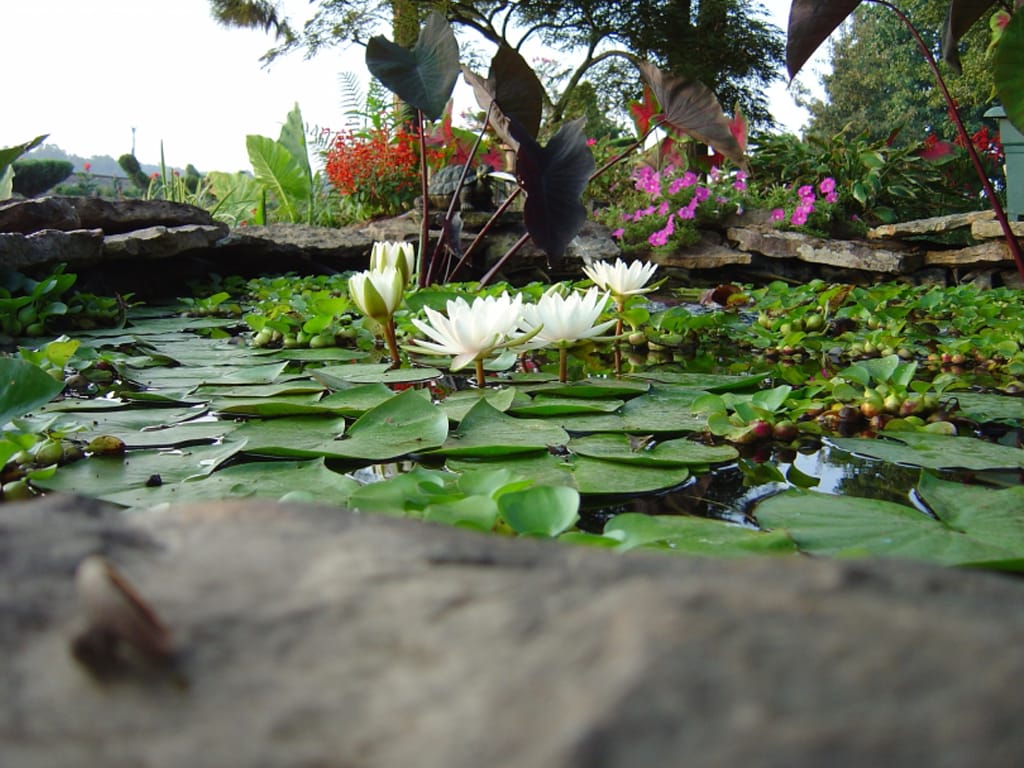
This image shows a peaceful pond filled with water lilies—plants with large, flat green leaves floating on the water's surface and beautiful white flowers blooming above the water. Around the pond are trees, shrubs with pink and red flowers, and logs that create homes for living things. The pond is a complete ecosystem where many plants and animals live together.
🔬 Scientific Phenomena
Anchoring Phenomenon: A pond is a freshwater habitat where plants and animals depend on each other to survive.
Why This Happens: Ponds form in low areas where water collects and stays. Plants like water lilies grow in ponds because they have adapted to live in water—their roots absorb nutrients from the muddy bottom, and their flat leaves float to catch sunlight. Animals are attracted to ponds because they need water to drink and plants provide food and shelter. The log, rocks, and surrounding vegetation create safe places for creatures to hide and live. This creates a balanced system where everything has a role: plants make food using sunlight, animals eat the plants or other animals, and dead materials return nutrients to the soil. This cycle repeats year after year.
📚 Core Science Concepts
- Habitats and Ecosystems: A pond is a habitat—a place where specific plants and animals live together. The pond ecosystem includes living things (plants, animals, insects) and nonliving things (water, rocks, soil, sunlight).
- Plant Adaptations: Water lilies have special features that help them survive in ponds. Their broad, flat leaves float and prevent them from sinking, while their long stems stretch down to the muddy bottom where roots absorb water and nutrients.
- Living Things Need Specific Conditions: Plants and animals in ponds need water, sunlight, shelter, and food. The trees, logs, and rocks provide shelter, while the water provides a home and drinking water for animals.
- Interdependence: Living things in a pond depend on each other. Plants need pollinators (like bees) to make seeds, animals eat plants for food, and decomposers break down dead material to return nutrients to the water and soil.
Pedagogical Tip:
Use the term "habitat" consistently throughout your lesson to build vocabulary. Have students physically sort pictures of animals and plants into "pond habitat" or "forest habitat" categories. This concrete sorting activity helps third graders understand that specific organisms belong in specific places because of their needs and adaptations.
UDL Suggestions:
Representation: Provide labeled diagrams of the pond ecosystem in addition to the photograph. Some students benefit from seeing simplified drawings with fewer details before engaging with the complex real image.
Action & Expression: Allow students to demonstrate understanding through multiple modalities—drawing a pond food chain, creating a three-dimensional diorama, or physically acting out how a water lily grows.
Engagement: Connect to student interests by asking, "Have you ever seen a pond, lake, or stream? What did you notice living there?" Personal connections increase motivation for reluctant learners.
🎓 NGSS Connections
Performance Expectation (3-LS1-1): Develop models to describe that organisms have unique and diverse life cycles but all have in common birth, growth, reproduction, and death.
Performance Expectation (3-LS2-1): Construct and interpret food chains and food webs in which the role of the producer, decomposer, and consumer can be identified.
Performance Expectation (3-LS4-3): Construct an argument that some animals form groups that help members survive.
---
Disciplinary Core Ideas:
- Growth and Development of Organisms
- Interdependent Relationships in Ecosystems
- Adaptation
- Earth's Materials
Crosscutting Concepts:
- (Seasonal changes affect pond organisms; organisms follow life cycle patterns)
- (Adaptations help organisms survive in their habitats)
- (A pond is a system where parts interact)
💬 Discussion Questions
- "What do you think the water lily plant needs to grow in the pond?" (Bloom's: Remember | DOK: 1)
- "Why do you think animals like to live near or in ponds? What does a pond give them?" (Bloom's: Understand | DOK: 2)
- "How do you think the trees help the pond animals, even though the trees don't live in the water?" (Bloom's: Analyze | DOK: 3)
- "If someone drained all the water from this pond, what would happen to the plants and animals that live there? Why?" (Bloom's: Evaluate | DOK: 3)
📖 Vocabulary
- Habitat: A place where an animal or plant lives and finds everything it needs to survive, like food, water, and shelter.
- Adaptation: A special body part or behavior that helps an animal or plant survive in its habitat (like a water lily's flat leaves that float).
- Ecosystem: A community of living things (plants, animals, insects) and nonliving things (water, soil, rocks, sunlight) that all interact together in one place.
- Decomposer: A living thing, like bacteria or fungi, that breaks down dead plants and animals and returns nutrients to the soil and water.
- Food Chain: The path that shows how energy moves from the sun to plants to animals in a habitat (example: sun → plant → insect → bird).
🌡️ Extension Activities
Activity 1: Create a Pond Diorama
Students build a three-dimensional model of a pond habitat using a small box, water (or blue paper), clay, and craft materials. They label living things (plants, animals) and nonliving things (rocks, logs, water). This hands-on activity reinforces the concept that a habitat contains both living and nonliving parts. It also allows students to apply what they've observed to create their own miniature ecosystem.
Activity 2: Design a Pond Food Chain Mobile
Students research or draw three organisms from a pond ecosystem (example: water plant, dragonfly, frog). They arrange pictures in a chain showing "who eats whom" and hang them from a coat hanger with string. Students present their mobile and explain the flow of energy through their food chain. This kinesthetic activity helps solidify understanding of producer-consumer relationships.
Activity 3: Observe a Classroom Aquatic Ecosystem
Set up a small aquarium or water table with aquatic plants, snails, and water. Over two weeks, students make daily observations and sketches of changes (plants growing, snails moving, algae forming). Students discuss: "What do we need to do to keep this mini-pond ecosystem healthy?" This ongoing observation builds scientific thinking and connects abstract concepts to real, visible changes.
🔍 Zoom In / Zoom Out Concepts
Zoom In: Microscopic Photosynthesis in Water Lily Leaves
Deep inside each water lily leaf are tiny green structures called chloroplasts. These are so small you need a microscope to see them! Inside the chloroplasts, something amazing happens: the plant uses sunlight, water from the pond, and a gas in the air (carbon dioxide) to make its own food. This process is called photosynthesis, and it's how the water lily grows bigger and makes energy to create beautiful flowers. We can't see this happening with our eyes, but it's going on right now in every green part of the plant!
Zoom Out: The Pond Within a Larger Watershed System
This single pond is actually part of something much bigger called a watershed—an area of land where all the water drains downhill toward rivers, streams, lakes, and eventually the ocean. Rain that falls on the trees and ground around this pond flows into it, bringing nutrients and water. The pond's water also evaporates into the air and becomes clouds. This pond is connected to other ponds, streams, and water systems nearby. What happens in this pond affects the water in the whole watershed, and what happens upstream (in forests and fields) affects this pond. The pond is one piece of a giant water cycle that connects the whole Earth!
🤔 Potential Student Misconceptions
Misconception 1: "Plants in water don't need soil to grow."
Clarification: Water lily plants DO need soil! Their long roots stretch down to the muddy bottom of the pond. The mud is like underwater soil—it contains nutrients and minerals that the roots absorb to help the plant grow. The water itself is not enough; the plant needs both water AND mud to survive. The difference is that water lily roots are adapted to work in wet, muddy conditions, unlike plants in a dry garden.
Misconception 2: "All the plants in a pond are under the water."
Clarification: Some pond plants live completely underwater, but others (like water lilies) float on top with leaves and flowers above the water. Some plants live along the edges of the pond in wet soil. And trees around the pond grow on dry land! A pond habitat includes plants living in different zones—underwater, on the surface, at the edge, and on land nearby. Each zone has different plants suited to those conditions.
Misconception 3: "The logs and rocks in a pond are just decoration; they don't help animals."
Clarification: Logs and rocks are very important! They provide shelter and hiding places for many animals like frogs, insects, and fish. Some animals use them as safe spots from predators, places to lay eggs, or spots to rest. Logs and rocks also create surfaces where algae and moss grow, which provide food for some pond animals. They're living furniture in the pond ecosystem!
🔗 Cross-Curricular Ideas
ELA Connection: "Write a Day in the Life" Narrative
Students choose a pond animal (frog, dragonfly, water lily, snail) and write a short story or journal entry describing one day in the life of that creature. Prompts might include: "What do you eat? Where do you hide? What dangers do you face?" This builds narrative writing skills while reinforcing habitat and ecosystem concepts. Students can illustrate their stories and create a class book titled "Voices from the Pond."
Math Connection: Measuring and Graphing Pond Data
Students measure the size of water lily leaves using rulers or string, record the measurements, and create a bar graph comparing leaf sizes. They could also count the number of flowers, buds, and lily pads visible in the photo and represent this data in a pictograph or simple chart. This integrates measurement and data representation with science observation.
Art Connection: Nature Collage and Color Study
Students create a mixed-media collage of the pond using tissue paper, natural materials (pressed leaves, twigs), and paint to recreate the colors and textures they see—the pink flowers, green leaves, blue water, and brown logs. This encourages close observation of color, pattern, and composition while celebrating the beauty of the habitat.
Social Studies Connection: "Protecting Our Local Pond"
Students research a real pond or wetland in their community (using library resources, interviews with park rangers, or virtual tours). They create a "preservation poster" with facts about the pond's plants and animals and explain why it's important to protect it. This connects environmental science to civic responsibility and teaches students that they can help protect nature in their own neighborhoods.
🚀 STEM Career Connection
- Botanist — Studies plants — how they grow, how they reproduce, and how they survive where they live.
- Try it: Build a model of a water lily using craft supplies and show how its leaves float and its roots reach the bottom. (Practice: Developing and Using Models)
- Tools: a hand lens, a plant press, a soil probe, field guides
- Where they work: botanical gardens, herbariums, forests and fields, universities
- Meet one: Robin Wall Kimmerer — Mosses — which she calls the coral reefs of the forest — and what Indigenous knowledge teaches about bringing plants back.
- Median pay: /year — "Soil and plant scientists"
- Ecologist — Studies how living things depend on each other and on the place they live.
- Try it: Create a diorama of a pond ecosystem, showing how the plants, animals, and non-living things interact. (Practice: Developing and Using Models)
- Tools: quadrat frames, measuring tapes, GPS units, a field notebook
- Where they work: forests, grasslands, wetlands, universities
- Meet one: Sandra Díaz — What a plant's leaves, wood and shape tell you about how it lives — and how those traits add up across a whole ecosystem.
- Median pay: /year — "Environmental scientists and specialists, including health"
Wage figures are median annual wages for the U.S. occupation named after each one, from the U.S. Bureau of Labor Statistics, Occupational Employment and Wage Statistics (OEWS), national, May 2025. Several careers share one occupation, so their figures match.
---
Teacher Tip: This lesson sequence works well over 2–3 weeks, starting with observation and vocabulary, moving to food chains and interdependence, and ending with a hands-on project. Consider taking a virtual or real field trip to a local pond or wetland to deepen engagement!