📸 Photo Description
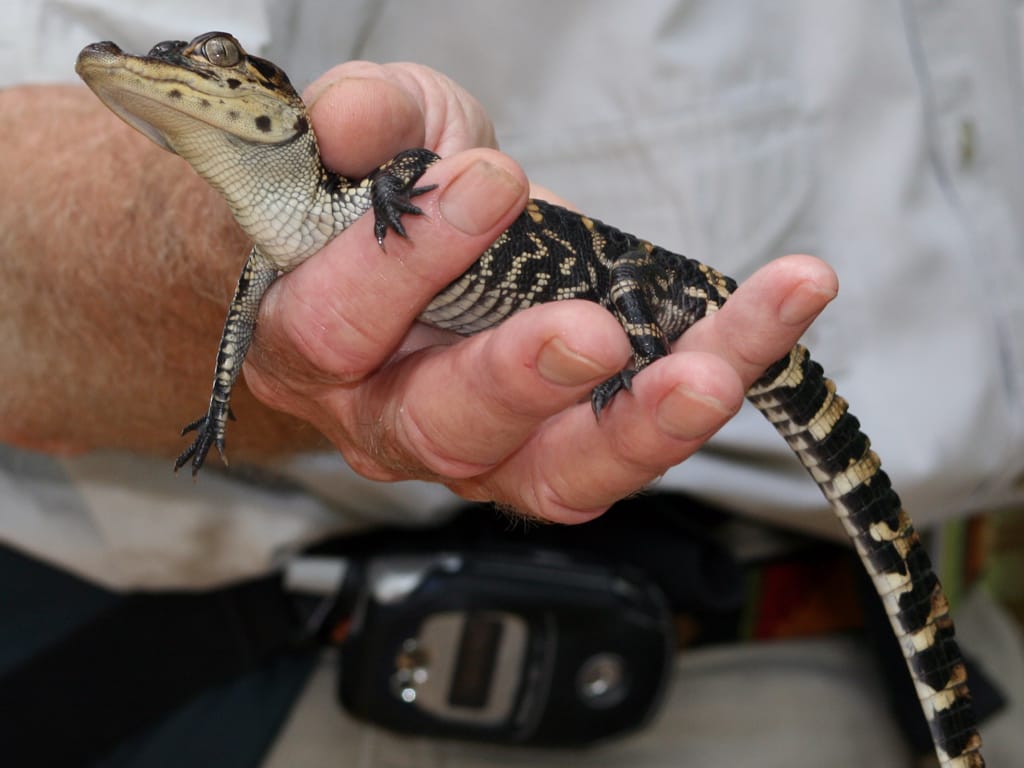
This image shows a young American alligator being held safely in a person's hand. You can see the alligator's bumpy, textured skin covering its body. The alligator has a long tail with dark and light stripes, small eyes on top of its head, and a mouth full of tiny teeth. The scales on its body help protect it and keep it waterproof.
🔬 Scientific Phenomena
Anchoring Phenomenon: Why do reptiles like alligators have scales covering their entire bodies?
Reptiles have scales as a crucial adaptation for survival. Scales are tough, overlapping pieces of skin made from a protein called keratin (the same material as human fingernails). These scales serve multiple functions: they protect the reptile's body from injury and predators, reduce water loss through the skin (essential for survival in both wet and dry environments), and provide camouflage through coloring and patterns. The scales also help reptiles move efficiently across different terrains. This is an example of how animals' body structures are perfectly suited to help them survive in their habitats.
📚 Core Science Concepts
- Adaptation: A body part or behavior that helps an animal survive and thrive in its environment. Scales are an adaptation that helps reptiles like alligators stay safe and healthy.
- Reptile Characteristics: Reptiles are cold-blooded animals covered in dry scales. They lay eggs and breathe air with lungs. Alligators, snakes, turtles, and lizards are all reptiles.
- Structure and Function: The scales on a reptile's body have a specific job—they protect the animal, keep moisture in, and help with movement. Different body parts have different purposes.
- Animal Classification: Scientists organize animals into groups based on shared characteristics. All reptiles share scales, cold-bloodedness, and egg-laying (though some give live birth).
Pedagogical Tip:
When teaching about scales, have students feel different textures (rough sandpaper, smooth plastic, bumpy bubble wrap) while blindfolded. This kinesthetic approach helps Third Graders understand that scales feel different from human skin and why that matters for survival. This bridges abstract concepts to concrete sensory experiences.
UDL Suggestions:
To support diverse learners: (1) Provide images of different reptiles with scales labeled in multiple languages for ELL students; (2) Create a tactile scale model using clay or foam so students with visual impairments can explore reptile structure; (3) Offer both video and illustrated text resources to accommodate different learning modalities; (4) Allow students to choose whether they present findings through drawing, writing, or verbal explanation.
🎓 NGSS Connections
Performance Expectation: 3-LS1-1
Students who demonstrate understanding can construct an evidence-based account that some animals form groups that help members survive.
Disciplinary Core Ideas:
- - Growth and Development of Organisms: Reproduction is essential to the continuation of every species. Animals have different ways of reproducing.
- - Natural Selection: Plants and animals have traits inherited from parents. Other traits result from individuals' interactions with the environment, which can affect survival.
- - Adaptation: For any particular environment, some kinds of animals survive well, some survive less well, and some cannot survive at all.
Crosscutting Concepts:
- - The shape and stability of structures of natural and designed objects are related to their function(s).
- - Events have causes that generate observable patterns.
💬 Discussion Questions
- What do you think would happen to an alligator if it didn't have scales? (Bloom's: Analyze | DOK: 2)
- How are a reptile's scales similar to and different from your own skin? (Bloom's: Compare/Contrast | DOK: 2)
- Why might an alligator's striped tail pattern be helpful for survival in a swampy environment? (Bloom's: Evaluate | DOK: 3)
- If you were designing a robot that needed to work in a wet, muddy environment, what features from reptile scales would you copy? (Bloom's: Create | DOK: 3)
📖 Vocabulary
- Scales: Thin, hard, overlapping pieces of skin that cover and protect a reptile's body.
- Reptile: A cold-blooded animal with scales, lungs for breathing, and usually lays eggs (examples: snakes, lizards, alligators, turtles).
- Adaptation: A body part or behavior that helps an animal survive and thrive in its home.
- Cold-blooded: An animal whose body temperature changes with the temperature of its surroundings (unlike warm-blooded animals like humans and birds).
- Camouflage: Colors or patterns on an animal's body that help it blend in with its surroundings and hide from predators.
- Waterproof: Something that does not allow water to pass through it; stays dry even when wet.
🌡️ Extension Activities
- Scale Rubbing Hunt: Take students on a nature walk to find different textured objects (tree bark, leaves, rocks, concrete). Have them make rubbings with paper and crayons, then compare the textures to reptile scales. Discuss how different textures serve different purposes in nature.
- Design Your Own Reptile: Provide students with templates or clay to design an imaginary reptile. They must include scales and explain (through drawing labels or written/verbal descriptions) how each adaptation helps their reptile survive in a specific habitat (desert, rainforest, swamp, etc.). This creative task connects structure-function relationships to design thinking.
- Reptile Sorting Game: Create cards with pictures of various animals (reptiles and non-reptiles). Students sort them by characteristics: Has scales? Lays eggs? Cold-blooded? This activity reinforces classification skills and deepens understanding of what makes reptiles unique.
🔍 Zoom In / Zoom Out Concepts
Zoom In: The Microscopic Level
If you could zoom in really close with a super-powerful microscope, you would see that each scale is made of tiny layers. The outermost layer is made of a protein called keratin—the same material that makes your fingernails hard and strong! Under the scale, there are even tinier structures called cells that work together to keep the scale strong and waterproof. These cells produce special oils that help water slide right off the scale, just like water beads up on a freshly waxed car. Without these microscopic structures working perfectly, the alligator's scales wouldn't protect it from getting too wet or too dry.
Zoom Out: The Ecosystem Level
When we zoom out and look at the bigger picture, we see that alligators with strong, waterproof scales are able to survive in swamps, wetlands, and rivers. Because their scales keep them healthy in wet environments, alligators can thrive where other animals cannot. They become top predators in their ecosystem, hunting fish and smaller animals. The alligator's success (thanks to its scales!) affects the entire food web—it controls populations of prey animals and provides food for scavengers when it dies. The scales that protect one animal actually help balance the entire wetland ecosystem and keep nature in harmony.
🤔 Potential Student Misconceptions
Misconception 1: "Reptile scales are like fish scales."
Many Third Graders think all scales are the same because they've seen pictures of fish and reptiles side-by-side. Clarification: While fish scales and reptile scales both protect the animal, they are quite different! Fish scales are smooth, shiny, and overlap like roof tiles, and they often fall off. Reptile scales are bumpy and textured, stay attached for the reptile's entire life, and are made of keratin (like your fingernails). Reptile scales also keep water OUT and moisture IN, while fish scales are made for moving smoothly through water.
Misconception 2: "Scales are like clothes that the alligator can take off."
Students may think scales are something an alligator wears rather than a part of its body. Clarification: Scales are actually part of the alligator's skin—they grow right out of it and are permanent. Just like you can't remove your skin, an alligator can't remove its scales. The scales are living tissue that protect the alligator's body underneath, similar to how your skin protects your muscles and bones.
Misconception 3: "All reptiles are the same because they all have scales."
Third Graders often overgeneralize that if animals share one feature, they must be identical. Clarification: While all reptiles have scales, they can be very different sizes, shapes, and textures! A snake's scales are smooth and shiny to help it slither, a turtle's scales form a hard shell for protection, and an alligator's scales are bumpy for camouflage in muddy water. Each reptile's scales are specially adapted for its own way of life.
🔗 Cross-Curricular Ideas
Math Connection: Measuring and Comparing
Have students measure and record the length of different reptile body parts using inch rulers or measuring tape. Create a simple bar graph comparing the head length, tail length, and body length of different reptiles (alligators, crocodiles, snakes, lizards). Students can practice data collection, measurement skills, and graphing while learning about reptile diversity. This reinforces both math standards and science observation skills.
ELA Connection: Descriptive Writing and Vocabulary
Ask students to write or dictate a descriptive paragraph about touching an alligator's scales (real or imagined). Encourage them to use sensory words: bumpy, rough, smooth, cool, hard, scaly. Create a class "texture word wall" together, then have students write short "scale poems" using rhyming or repetitive language patterns. This builds vocabulary related to texture and structure while developing writing skills.
Social Studies Connection: Animal Habitats and Geography
Research where alligators live in the United States (primarily Florida, Louisiana, and the Gulf Coast). Locate these areas on a U.S. map and discuss what makes swamps and wetlands special places. Compare the geography, climate, and human communities in alligator habitats versus your local area. Students can create a simple map showing alligator territory and label features like rivers, swamps, and cities, building geography and map-reading skills.
Art Connection: Texture Exploration and Camouflage Art
Have students create a mixed-media artwork inspired by reptile scales and camouflage patterns. Provide various textured materials (sandpaper, bubble wrap, corrugated cardboard, fabric scraps) and have students glue them onto paper in scale-like patterns. Then challenge them to paint or color their creation to help an imaginary reptile "hide" in a specific environment (desert, forest, swamp). This integrates fine motor skills, artistic expression, and understanding of how adaptation serves survival.
🚀 STEM Career Connection
- Herpetologist — Studies reptiles and amphibians — snakes, lizards, frogs and turtles.
- Try it: Compare the scales of a snake and a lizard, explaining how their different scale structures might help each animal. (Practice: Structure and Function)
- Tools: snake hooks, pitfall traps, temperature probes, a field notebook
- Where they work: deserts and wetlands, zoos, natural history museums, universities
- Meet one: Earyn McGee — What happens to desert lizards when the streams they live near dry up.
- Median pay: /year — "Zoologists and wildlife biologists"
- Biomimicry Engineer — Copies a solution nature already found — a burr, a beak, a leaf — and builds it into a design.
- Try it: Design a way to keep a toy dry using overlapping pieces, similar to how reptile scales work. (Practice: Structure and Function)
- Tools: microscopes, 3D printers, prototype rigs, CAD software
- Where they work: design studios, research labs, product companies, universities
- Meet one: Ainissa Ramirez — How to make metal stick to glass and ceramics — she invented a solder that does it.
- Median pay: /year — "Engineers, all other"
Wage figures are median annual wages for the U.S. occupation named after each one, from the U.S. Bureau of Labor Statistics, Occupational Employment and Wage Statistics (OEWS), national, May 2025. Several careers share one occupation, so their figures match.
---
Teacher Note: This lesson leverages the visual anchor of a real alligator to make the abstract concept of adaptation concrete. Third Graders are naturally curious about animals, so this image provides an excellent hook for deeper exploration of how structure supports survival.