📸 Photo Description
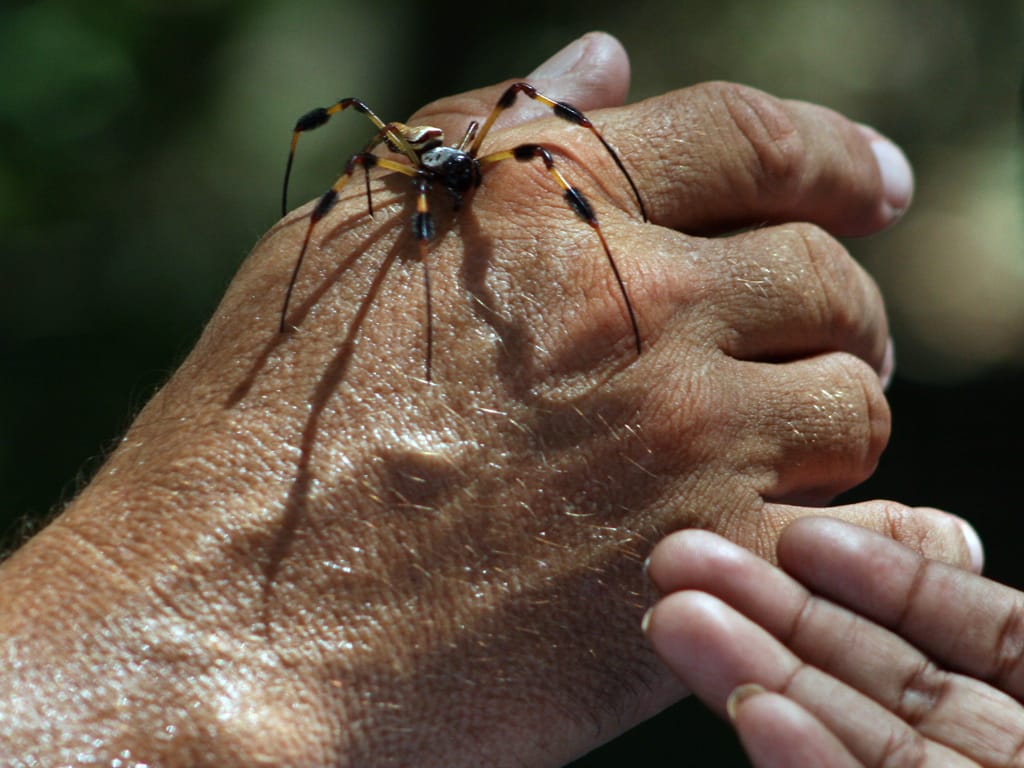
This image shows a large spider resting on a person's hand. The spider has long, thin legs, a brown and tan colored body, and small eyes. You can see the detailed texture of the human skin and how tiny the spider looks compared to the hand, which helps us understand the spider's actual size.
🔬 Scientific Phenomena
Anchoring Phenomenon: Why do spiders sometimes crawl on people, and how do they move so carefully?
This image captures a spider exhibiting natural exploration and movement behavior. Spiders are predators that actively hunt for food and new habitats. When a spider encounters a hand, it is simply exploring—trying to find food or a safe place to go. The spider can walk on the hand because its legs have tiny claws and sticky toe pads that grip surfaces, allowing it to move smoothly even on smooth, curved surfaces like human skin. The spider is not trying to bite or hurt the person; it is simply moving through its environment the way it normally does on leaves, rocks, and soil.
📚 Core Science Concepts
- Adaptations for Movement: Spiders have eight jointed legs with special claws and sticky pads on their feet. These adaptations allow them to climb, walk, and grip almost any surface, including vertical walls and smooth skin.
- Sensory Abilities: Spiders have multiple eyes (usually eight) and special hairs on their legs that detect vibrations. These help spiders sense their surroundings and find food, even in darkness.
- Habitat and Behavior: Spiders are found in almost every environment on Earth—gardens, homes, forests, and deserts. They actively explore and hunt to survive.
- Predator Role in Food Chains: Spiders eat insects like flies, mosquitoes, and other small creatures. This makes spiders important predators that help control pest populations in nature.
Pedagogical Tip:
Many Third Graders have fear or misconceptions about spiders. Use this image as an opportunity to build scientific curiosity rather than fear. Emphasize that spiders are beneficial, usually harmless to humans, and fascinating to study. Invite students to observe spiders in their natural outdoor habitats with magnifying glasses rather than handling them directly—this builds observation skills while respecting the animal's safety.
UDL Suggestions:
Multiple Means of Representation: Provide the image alongside a large diagram labeling spider body parts (head, thorax, abdomen, legs). Use color coding to help students distinguish structures. For kinesthetic learners, allow students to create spider leg movements using their arms and practice the eight-legged walk.
Multiple Means of Engagement: Connect spiders to student interests (e.g., "Spiders are like tiny superheroes with special powers!"). Offer choice in extension activities—some students may prefer drawing spiders, others may research them, and others may act out spider behaviors.
Multiple Means of Expression: Allow students to demonstrate understanding through drawings, verbal explanations, written sentences, or physical models rather than requiring only written work.
🎓 NGSS Connections
Performance Expectation: 3-LS1-1 Develop models to describe that organisms have unseen parts that help them survive, grow, and meet their needs.
Disciplinary Core Ideas:
- Structure and Function—Students observe that the spider's leg structure, claws, and sensory hairs are specialized parts that enable survival.
- Natural Selection—The spider's adaptations (sticky feet, multiple eyes, leg design) have evolved because they help spiders survive and find food.
Crosscutting Concepts:
- —The spider's eight legs and special foot pads have a specific function: movement on any surface.
💬 Discussion Questions
- What special body parts does the spider have that help it walk on the person's hand? (Bloom's: Understand | DOK: 1)
- Why do you think spiders have eight legs instead of just four like many other animals? (Bloom's: Analyze | DOK: 2)
- How might a spider's ability to climb smooth surfaces help it survive in nature? (Bloom's: Analyze | DOK: 2)
- If you were a tiny spider, what would you find to eat in your classroom or house? How would you hunt for it? (Bloom's: Create | DOK: 3)
📖 Vocabulary
- Adaptation: A special body part or behavior that helps an animal survive and do what it needs to do.
- Predator: An animal that hunts and eats other animals for food.
- Arachnid: The group of animals that includes spiders, scorpions, and ticks—they all have eight legs.
- Thorax: The middle body section of a spider where the legs are attached.
- Abdomen: The back body section of a spider that contains the belly and is often the largest part.
- Silk: A thin, strong thread that many spiders make from their bodies to build webs.
🌡️ Extension Activities
- Spider Observation Hunt: Take students outdoors on a safe spider hunt using magnifying glasses. Look under leaves, on walls, and in corners for real spiders in their natural habitats. Have students sketch what they observe and describe the spider's size, color, and location. Discuss how spiders help the garden by eating pests.
- Model a Spider's Legs: Provide each student with a paper cup (body), eight pipe cleaners (legs), and googly eyes. Students assemble a 3D spider model and practice moving all eight legs in coordination. Ask: "What happens if one leg doesn't work? Can the spider still walk?" This kinesthetic activity helps students understand the function of multiple legs.
- Spider Web Investigation: Show students photos or real examples of different spider web types (orb webs, funnel webs, cobwebs). Discuss why different spiders build different webs and how the web design helps them catch food. Students can create a web design on paper or string and explain why they designed it that way.
🔍 Zoom In / Zoom Out Concepts
Zoom In: Microscopic Spider Structures
If we could shrink down to the size of a grain of sand and look at the bottom of a spider's foot with a powerful microscope, we would see tiny hairs and sticky pads called setae (SAY-tee). These microscopic structures work like nature's Velcro or glue, helping the spider grip even the smoothest surfaces. Each hair is so small that thousands of them fit on just one spider foot! This is why the spider can walk on the person's hand without slipping—those invisible hairs are doing all the gripping work.
Zoom Out: Spider's Role in the Outdoor Ecosystem
When we zoom out and see the bigger picture, this one spider on a hand is actually part of a much larger community of living things. In a garden, forest, or backyard, spiders are important hunters that eat hundreds of insects like flies, mosquitoes, and gnats. Without spiders, insects would multiply so much that plants wouldn't have enough leaves to eat, and people would be bothered by many more bugs. Spiders are also food for birds, lizards, and wasps. So this tiny spider is connected to a whole food web where it plays an important role in keeping nature in balance.
🤔 Potential Student Misconceptions
Misconception 1: "All spiders are dangerous and will bite me."
Scientific Clarification: Most spiders are not aggressive toward humans and will only bite if they feel trapped or threatened. Spiders actually prefer to run away from people rather than attack. Spider bites are rare, and the spider in the photo is simply exploring and looking for food—not trying to hurt anyone. Spiders are actually helpful to humans because they eat pests like mosquitoes and flies.
Misconception 2: "Spiders are insects because they have lots of legs."
Scientific Clarification: Spiders are not insects—they belong to a different animal group called arachnids (uh-RACK-nidz). Insects have 6 legs and 3 body parts, while spiders have 8 legs and 2 body parts. It's an easy mistake to make because they're both small creatures with legs, but they are different types of animals.
Misconception 3: "The spider is crawling on the hand to look for blood or to drink water from skin."
Scientific Clarification: Spiders don't drink blood—they are carnivores that eat other insects and small creatures. When a spider crawls on your skin, it's simply exploring and looking for tiny insects to eat or a new place to live. It treats your hand like it would treat a leaf or a rock in nature.
🔗 Cross-Curricular Ideas
Math: Spider Leg Measurements and Comparisons
Have students use rulers to measure the length of the spider's legs in the photo (or draw a life-size spider based on actual measurements). Create a simple bar graph comparing the leg length of different spider species. Students can also count: "If a spider has 8 legs and each leg has 7 sections called segments, how many segments does one spider have in total?" (56 segments). This builds multiplication skills while deepening understanding of spider anatomy.
ELA: Spider Storytelling and Descriptive Writing
Ask students to write a short story from the spider's point of view: "A Day in My Life as a Spider." Students use sensory descriptive words (crawly, tickly, sticky, smooth) to describe how the spider experiences the world. They can also read aloud The Very Busy Spider by Eric Carle and discuss how the author uses repetitive language and illustrations to tell the spider's story. This builds narrative writing and reading comprehension skills.
Art: Spider Web Design and Symmetry
Students create their own spider web designs using string, yarn, or paint on paper. Discuss how many spider webs have symmetrical patterns—they're balanced and beautiful. Students can explore geometric shapes and patterns while creating their webs. Display finished webs around the classroom and have students describe the symmetry they see. This connects art, mathematics (symmetry), and science (spider engineering).
Social Studies: Spiders Around the World
Students research spiders from different countries and habitats: jumping spiders in Australia, tarantulas in South America, fishing spiders near water, and desert spiders. Create a world map showing where different spider species live and what makes their habitats special. Discuss how spiders adapt to hot deserts, cold forests, and wet rainforests. This builds geography skills and appreciation for biodiversity across cultures and regions.
🚀 STEM Career Connection
- Animal Behaviourist — Watches what animals do and works out why they do it.
- Try it: Construct an explanation for why a spider might crawl on a person, using evidence about its senses and movement. (Practice: Constructing Explanations and Designing Solutions)
- Tools: observation blinds, video recorders, stopwatches, behaviour checklists
- Where they work: zoos, field research stations, farms, universities
- Meet one: Rae Wynn-Grant — Where black bears and people run into each other, and how to keep both safe.
- Median pay: /year — "Zoologists and wildlife biologists"
- Biologist — Studies living things of every kind and what keeps them alive.
- Try it: Design a solution to help a spider safely cross a small gap, considering its leg structure and how it moves. (Practice: Constructing Explanations and Designing Solutions)
- Tools: microscopes, sample jars, measuring tools, a field notebook
- Where they work: laboratories, field sites, museums, universities
- Meet one: Sandra Díaz — What a plant's leaves, wood and shape tell you about how it lives — and how those traits add up across a whole ecosystem.
- Median pay: /year — "Biological scientists, all other"
Wage figures are median annual wages for the U.S. occupation named after each one, from the U.S. Bureau of Labor Statistics, Occupational Employment and Wage Statistics (OEWS), national, May 2025. Several careers share one occupation, so their figures match.
---
Teacher Note: This lesson opportunity transforms a common "ick" moment into genuine scientific inquiry. By helping Third Graders see spiders as fascinating creatures with remarkable adaptations, you build both scientific thinking and environmental appreciation.