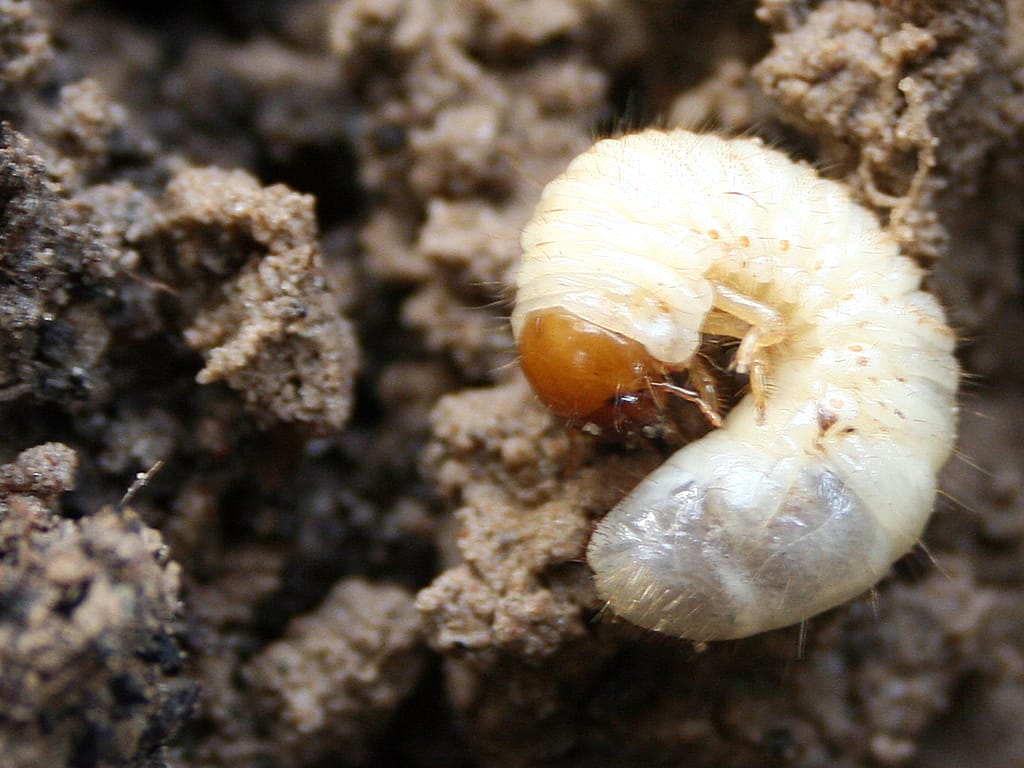
📸 Photo Description
This image shows a pale, curved larva (baby insect) with a brown head resting on sandy soil. The larva's soft, wrinkled body is very different from adult insects because it is still growing and developing. You can see the larva is surrounded by dirt and sand, which is where many insect babies live and eat.
🔬 Scientific Phenomena
Anchoring Phenomenon: Why do insects look so different when they are babies than when they are adults?
This larva is undergoing metamorphosis—a dramatic change in body shape and appearance as it grows. Insect larvae must go through several stages of development before becoming adults. During this time, the larva's job is to eat and grow larger. As it grows, its skin becomes too tight, so it sheds its outer layer (called molting) and grows a new, larger skin underneath. This process repeats several times until the larva is ready to transform into an adult insect. This happens because different life stages have different jobs: larvae focus on eating and growing, while adults focus on finding mates and laying eggs.
📚 Core Science Concepts
- Life Cycles: All living things go through stages of growth and change from birth to adulthood. For insects like this larva, the stages are egg → larva → pupa → adult.
- Adaptation and Survival: Larvae have features (like their soft bodies and strong jaws) that help them survive. Their pale color helps them hide in soil, and their curved shape helps them move through dirt to find food.
- Growth and Change: Organisms grow larger and change shape over time. This larva will eventually look completely different when it becomes an adult insect.
- Habitats and Environment: Larvae live in specific places where they can find food and stay safe. This larva's sandy home provides shelter and access to the organic matter it eats.
Pedagogical Tip:
Use this image as a "mystery photo" at the start of your lesson! Ask students, "What is this creature?" and let them make observations before revealing it's an insect larva. This builds curiosity and engagement. Then, show them what the adult version looks like—the contrast is powerful and memorable for third graders.
UDL Suggestions:
Representation: Provide a visual chart showing the insect life cycle with pictures alongside words. Some students may benefit from a simplified 2-stage version (larva → adult) before learning the complete 4-stage cycle. Action & Expression: Allow students to show their understanding through drawing their own larva, building a 3D model with clay, or acting out the metamorphosis process with body movements. Engagement: Connect to student interests by asking, "What insects have you seen in your yard or garden?" to make the content personally relevant.
🎓 NGSS Connections
Performance Expectation:
3-LS1-1: Develop models to describe that organisms have unique and diverse life cycles but all animals have in common birth, growth, reproduction, and death.
Disciplinary Core Ideas:
- : Growth and Development of Organisms
- : Life Cycles and Traits
Crosscutting Concepts:
- : Life cycles follow predictable patterns.
- : The larva's body structure is suited to its job of eating and growing.
💬 Discussion Questions
- What do you think this larva's job is in this stage of its life? (Bloom's: Understand | DOK: 1)
- Why do you think the larva is pale (light-colored) instead of bright and colorful like some adult insects? (Bloom's: Analyze | DOK: 2)
- If we found this larva in the soil, what would we need to do to keep it safe and healthy while we observe it? (Bloom's: Apply | DOK: 2)
- How do you think the larva's body will change before it becomes an adult insect? What will stay the same? (Bloom's: Synthesize | DOK: 3)
📖 Vocabulary
- Larva: A baby insect that looks very different from the adult form and has a job of eating and growing.
- Metamorphosis: A big, dramatic change in how an animal looks as it grows from a baby to an adult.
- Molt: When an animal sheds (takes off) its outer skin because it has grown too big for it.
- Life Cycle: All the different stages an animal goes through from birth until it becomes an adult and has babies of its own.
- Habitat: The place where an animal lives and finds food and shelter.
- Adaptation: A special body part or behavior that helps an animal survive in its home.
🌡️ Extension Activities
- Larva Hunt and Observation: Take students on a safe outdoor exploration to find real larvae (under logs, in leaf litter, or in soil). Have them sketch what they observe and record observations on a simple chart: size, color, shape, and location found. This connects classroom learning to real-world science.
- Life Cycle Sequencing Game: Create or print large illustrated cards showing the four stages of an insect's life cycle (egg, larva, pupa, adult). Have students arrange the cards in order, then mix them up and repeat. Extend by having students explain what happens at each stage using sentence frames like, "The _____ eats a lot and grows bigger."
- Build a Larva Model: Provide clay, pipe cleaners, and other craft materials for students to sculpt their own larva models based on the photo. Have them label body parts (head, segments, legs) and write one fact about what they learned about larvae.
🔍 Zoom In / Zoom Out Concepts
Zoom In: Inside the Larva's Body
Even though we can't see it without a microscope, inside this larva's body are tiny structures called cells that are working hard! The larva's cells are constantly growing bigger and multiplying (making copies of themselves) so the whole larva gets larger. The larva also has a simple digestive system—basically a tube from its mouth to its rear end—that breaks down soil and plant material into energy it needs to grow. As cells multiply and grow, the larva's outer skin (called an exoskeleton) can't stretch anymore, which is why the larva must molt and grow a new, bigger skin!
Zoom Out: The Larva's Role in the Soil Ecosystem
This tiny larva is part of a much bigger system! As the larva eats dead leaves, wood, and organic matter in the soil, it helps break down these materials and recycles nutrients back into the earth. This makes the soil richer and healthier for plants to grow. Plants feed herbivores (plant-eaters), which feed carnivores (meat-eaters)—and this larva is food for birds, beetles, and other animals! When the larva becomes an adult insect, it may pollinate flowers or become prey for larger animals. Every creature in the soil, from bacteria to earthworms to this larva, works together to keep the soil alive and fertile.
🤔 Potential Student Misconceptions
Misconception 1: "The larva is a different animal than the adult insect, not the baby version."
Clarification: The larva IS the baby form of this insect—it's the same creature, just at a different stage of life, like how a human baby grows into a human adult. The larva will transform into an adult insect of the same species through metamorphosis. It's not a separate animal; it's the same animal at a different age.
Misconception 2: "Insects grow by getting bigger and bigger, just like humans do."
Clarification: Insects can't grow continuously like humans because their exoskeleton (hard outer skin) doesn't stretch. Instead, they grow in steps: they eat and grow until their skin gets too tight, then they molt (shed that skin) and grow a new, bigger one. This happens several times until they're ready to become adults. It's like outgrowing your clothes and needing bigger ones!
Misconception 3: "All larvae look like tiny worms, and all adult insects look the same."
Clarification: Larvae come in many different shapes and sizes depending on what type of insect they are. Some look like worms, but others look like grubs, caterpillars, or even tiny versions of adults! Similarly, adult insects are very different from each other—beetles, butterflies, ants, and dragonflies all look completely different. The amazing thing is that one larva can transform into a very different-looking adult through metamorphosis.
🔗 Cross-Curricular Ideas
Math: Create a life cycle timeline where students use a measuring tape or string to mark distances representing the four stages of an insect's life cycle. For example, they might say the egg stage lasts 5 days (measure 5 inches), the larva stage lasts 30 days (measure 30 inches), etc. Students can then add the distances together to find the total length of time for a complete life cycle, practicing addition and measurement skills.
ELA (Writing & Speaking): Have students write or dictate a "Day in the Life" journal entry from the perspective of the larva in the photo. Prompts might include: "What did I eat today? Where did I go? What did I see in the soil? Am I getting bigger?" This builds narrative writing skills and deepens understanding of the larva's daily experience. Students can illustrate their journal entries and share them aloud with the class.
Art: Students create a metamorphosis flip book or accordion-fold drawing showing the larva transforming into an adult insect across 4-6 pages. They can use watercolors, colored pencils, or collage materials to show the dramatic body changes. This tactile, visual project reinforces the sequence of life stages and allows creative expression while cementing science learning.
Social Studies: Connect to local habitats and community science. Research native insects in your region (with a focus on larvae) and create a classroom "Insect Passport" or guidebook. Students can interview family members about insects they've noticed in their gardens or yards, then compile this information into a class booklet. This builds community engagement, local awareness, and teaches students that science happens in their own neighborhoods.
🚀 STEM Career Connection
- Conservation Biologist — Works out which plants and animals are in trouble, and what would help them recover.
- Try it: Draw a picture of the larva in its habitat and label the things it needs to survive, like food and shelter. (Practice: Developing and Using Models)
- Tools: population surveys, GPS trackers, habitat maps, trail cameras
- Where they work: nature reserves, conservation charities, government agencies, universities
- Meet one: Tierra Curry — Which plants and animals are closest to disappearing, and what it takes to save them.
- Median pay: /year — "Zoologists and wildlife biologists"
- Ecologist — Studies how living things depend on each other and on the place they live.
- Try it: Make a model that shows how the larva interacts with its environment, like burrowing in soil. (Practice: Developing and Using Models)
- Tools: quadrat frames, measuring tapes, GPS units, a field notebook
- Where they work: forests, grasslands, wetlands, universities
- Meet one: Sandra Díaz — What a plant's leaves, wood and shape tell you about how it lives — and how those traits add up across a whole ecosystem.
- Median pay: /year — "Environmental scientists and specialists, including health"
Wage figures are median annual wages for the U.S. occupation named after each one, from the U.S. Bureau of Labor Statistics, Occupational Employment and Wage Statistics (OEWS), national, May 2025. Several careers share one occupation, so their figures match.