📸 Photo Description
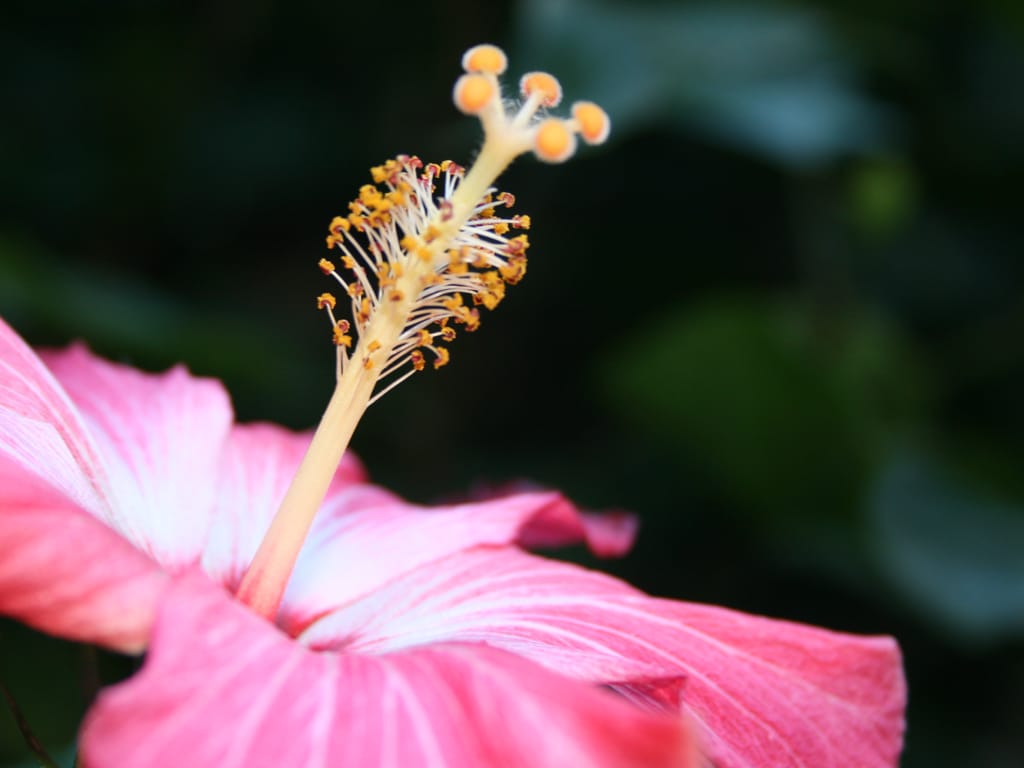
This image shows a bright pink flower with a long, thin structure sticking up from its center that has yellow dust-like particles and round balls at the tip. The colorful petals and the special center part help the flower make seeds and attract insects and animals that help it grow.
🔬 Scientific Phenomena
Anchoring Phenomenon: Why do flowers have colorful petals and sticky, dusty parts in the middle?
Flowers are structured this way to attract pollinators—insects, birds, and other animals—that help plants reproduce. The bright pink petals catch the attention of pollinators, while the stamen (the male part shown in the photo with the yellow pollen) produces pollen grains. When pollinators visit the flower to drink nectar or collect pollen for food, pollen sticks to their bodies and gets transferred to other flowers. This process, called pollination, allows plants to create seeds and make new plants. The round structures at the tip of the stamen will eventually develop into seeds if pollination is successful.
📚 Core Science Concepts
- Flower Parts Have Different Jobs: Flowers have multiple parts, each with a specific function. The petals attract pollinators, the stamen produces pollen, and the pistil (female part) receives pollen to make seeds.
- Pollination is Essential for Plant Reproduction: Plants depend on pollinators—bees, butterflies, hummingbirds, and wind—to move pollen between flowers so seeds can form and new plants can grow.
- Adaptation and Structure: The bright colors, sweet smell, and nectar of flowers are adaptations that have evolved to attract the specific animals that pollinate them most effectively.
- Interdependence in Ecosystems: Flowers and their pollinators have a mutually beneficial relationship; plants provide food (nectar and pollen), and animals help plants reproduce.
Pedagogical Tip:
Use the "flower dissection" approach cautiously with third graders. Rather than cutting flowers, have students use hand lenses to observe the stamen and pistil in situ. This preserves wonder, allows repeated observation, and prevents student frustration with delicate structures. You might bring in extra flowers specifically for careful disassembly, modeling how to gently separate petals and identify parts before students try independently.
UDL Suggestions:
Provide multiple means of representation by offering: (1) a large, labeled diagram of flower parts that students can reference; (2) real flowers to observe directly with hand lenses; and (3) a digital animation showing how pollen moves from flower to flower. For engagement, allow students to choose how they document their observations: drawing, writing, or dictating to a peer or adult. This honors diverse learning preferences and language levels.
🎓 NGSS Connections
Performance Expectation:
3-LS1-1: Develop models to describe that organisms have unseen parts that perform specific functions necessary for survival.
Disciplinary Core Ideas:
- (Structure and Function): Students learn that flowers have specialized parts that perform distinct functions in reproduction.
- (Adaptation): Students explore how flower structures (colors, shapes, scents) are adaptations that attract pollinators.
Crosscutting Concepts:
- : Understanding that a flower's form (bright petals, pollen-producing stamen) directly supports its function (attracting pollinators and reproducing).
- : Recognizing that flowers are part of larger ecosystems where plants and pollinators interact.
💬 Discussion Questions
- What do you think the yellow, dusty powder (pollen) on the stamen is used for? (Bloom's: Infer | DOK: 2)
- Why do you think flowers are so colorful and pretty instead of being plain green like leaves? (Bloom's: Evaluate | DOK: 3)
- If there were no bees or butterflies to visit flowers, what might happen to the plants? (Bloom's: Analyze | DOK: 2)
- How do you think the pollen gets from one flower to another flower that might be far away? (Bloom's: Create | DOK: 3)
📖 Vocabulary
- Stamen: The male part of a flower that makes yellow pollen (the dusty powder).
- Pollen: Tiny grains of dust made by flowers that help make new seeds.
- Pollinator: An animal like a bee or butterfly that carries pollen from flower to flower.
- Petals: The colorful leaves of a flower that help attract pollinators.
- Pistil: The female part of a flower that catches pollen and makes seeds.
- Adaptation: A special feature or behavior that helps a plant or animal survive and do well in its environment.
🌡️ Extension Activities
- Flower Observation Station: Set up a table with 2–3 different types of real flowers (roses, tulips, hibiscus, sunflowers) and hand lenses. Students rotate through, sketching the flowers and labeling the stamen, petals, and pistil using a provided diagram. Record observations: What colors do you see? Do all flowers smell the same? How many petals does each flower have?
- Pollinator Simulation Game: Create a classroom activity where students act as pollinators. Give each student a small paintbrush or cotton swab and dust one flower model with washable paint or powder. Students "visit" other flower stations around the room, transferring the dust between flowers. Afterward, discuss what they learned about how pollen moves and why it matters.
- Flower Life Cycle Documentation: Have students plant fast-growing flowers (like zinnias or marigolds) in small pots or a class garden bed. Over 4–6 weeks, have them photograph and sketch the progression from seed to sprouting, flowering, and pollination. Create a visual timeline showing the stages and predict when seeds will develop.
🔍 Zoom In / Zoom Out Concepts
Zoom In: The Microscopic World of Pollen
If we could shrink down and look at the yellow pollen dust under a microscope, we'd see that each tiny grain is actually a special package made by the flower. Inside each pollen grain are instructions (called DNA) that will help make a new plant. When a pollen grain lands on another flower's pistil, it grows a tiny tube down into the flower to deliver those instructions. It's like a super-small delivery truck carrying a secret message to help create seeds!
Zoom Out: Flowers in the Ecosystem Web
This single pink flower is connected to a much bigger world. The flower depends on pollinators like bees and butterflies to reproduce. Those pollinators need flowers for food (nectar and pollen). Birds eat the seeds that form after pollination. Decomposers break down fallen flowers and leaves, returning nutrients to the soil. All these connections—flowers, insects, birds, soil, and plants—work together in a web of life called an ecosystem. Without flowers, many animals would lose their food source, and without pollinators, flowers couldn't make seeds to grow new plants.
🤔 Potential Student Misconceptions
Misconception 1: "Pollen is dirt or dust that makes you sneeze, so it must be bad for flowers."
Clarification: While pollen can make some people sneeze (an allergic reaction), pollen is actually a healthy and important part of flowers. Pollen is made by flowers to help them reproduce. When people sneeze from pollen, it's because their body is reacting to it, but the pollen itself isn't bad—it's just doing its job in nature. Pollen helps flowers make seeds so new plants can grow.
Misconception 2: "All flowers need bees or butterflies, or they won't make seeds."
Clarification: While many flowers rely on insects for pollination, some flowers get pollinated by wind, water, or hummingbirds instead. Some flowers can even pollinate themselves. Different flowers have different strategies to move pollen around. Bees and butterflies are very important pollinators for many garden and wildflowers, but they're not the only way flowers reproduce.
Misconception 3: "The yellow pollen and the round balls at the tip of the stamen are the same thing."
Clarification: The yellow pollen is the dusty powder made by the anther (the tip of the stamen). The round balls students see are clusters of pollen sacs or the developing pollen structures themselves. The pollen is what gets transferred to other flowers; the structures holding the pollen are part of the stamen's design to display and release that pollen effectively.
🔗 Cross-Curricular Ideas
Math Connection: Counting and Measuring Flower Parts
Have students count the number of petals on several different flowers and create a simple bar graph or tally chart comparing petal counts across flower types. They can also measure the length of the stamen using a ruler or non-standard units (like paperclips) and compare measurements. This builds data collection and graphing skills while deepening observation of flower structure.
ELA Connection: Writing Flower Descriptions and Poetry
Students can write descriptive paragraphs or short poems about the flower in the photo, using sensory words (colors, textures, smells). Create a classroom "Flower Poetry" book where each student illustrates and writes about a real flower they've observed. This integrates vocabulary development, descriptive writing, and creativity while reinforcing flower terminology.
Art Connection: Flower Painting and Collage
Have students paint or create collages of flowers, focusing on color mixing and realistic detail of flower parts. They can use the photo as inspiration to practice realistic representation or create abstract interpretations. Display student artwork alongside labeled diagrams of flower parts, combining science with artistic expression.
Social Studies Connection: Flowers Around the World
Explore how different cultures use flowers—in celebrations, medicine, food, and traditions. Students can research flowers from different countries (cherry blossoms in Japan, marigolds in India, sunflowers in Ukraine) and discuss why those flowers are important to those cultures. This builds global awareness and shows that science connects to how people live in different parts of the world.
🚀 STEM Career Connection
- Botanist — Studies plants — how they grow, how they reproduce, and how they survive where they live.
- Try it: Create a model of a flower using paper and explain the job of each part, like petals attracting pollinators and the center holding pollen. (Practice: Developing and Using Models)
- Tools: a hand lens, a plant press, a soil probe, field guides
- Where they work: botanical gardens, herbariums, forests and fields, universities
- Meet one: Robin Wall Kimmerer — Mosses — which she calls the coral reefs of the forest — and what Indigenous knowledge teaches about bringing plants back.
- Median pay: /year — "Soil and plant scientists"
- Gardener — Plants and tends growing things, and learns by watching what thrives where.
- Try it: Draw a diagram of a flower and explain how its parts help it get pollinated so it can make seeds. (Practice: Developing and Using Models)
- Tools: trowels, watering systems, compost, pruning shears
- Where they work: public gardens, school grounds, parks, private gardens
- Meet one: Carlos Magdalena — How to bring the world's rarest plants back from the edge, including the smallest water lily on Earth after it vanished from the wild.
- Median pay: /year — "Landscaping and groundskeeping workers"
Wage figures are median annual wages for the U.S. occupation named after each one, from the U.S. Bureau of Labor Statistics, Occupational Employment and Wage Statistics (OEWS), national, May 2025. Several careers share one occupation, so their figures match.
---
Teacher Notes: This lesson builds on third graders' natural curiosity about nature and aligns with their developing ability to understand how organisms depend on each other. Use the real flower image and hands-on activities to anchor abstract concepts like pollination. Encourage outdoor observation of real flowers and insects to deepen understanding and foster environmental stewardship.