📸 Photo Description
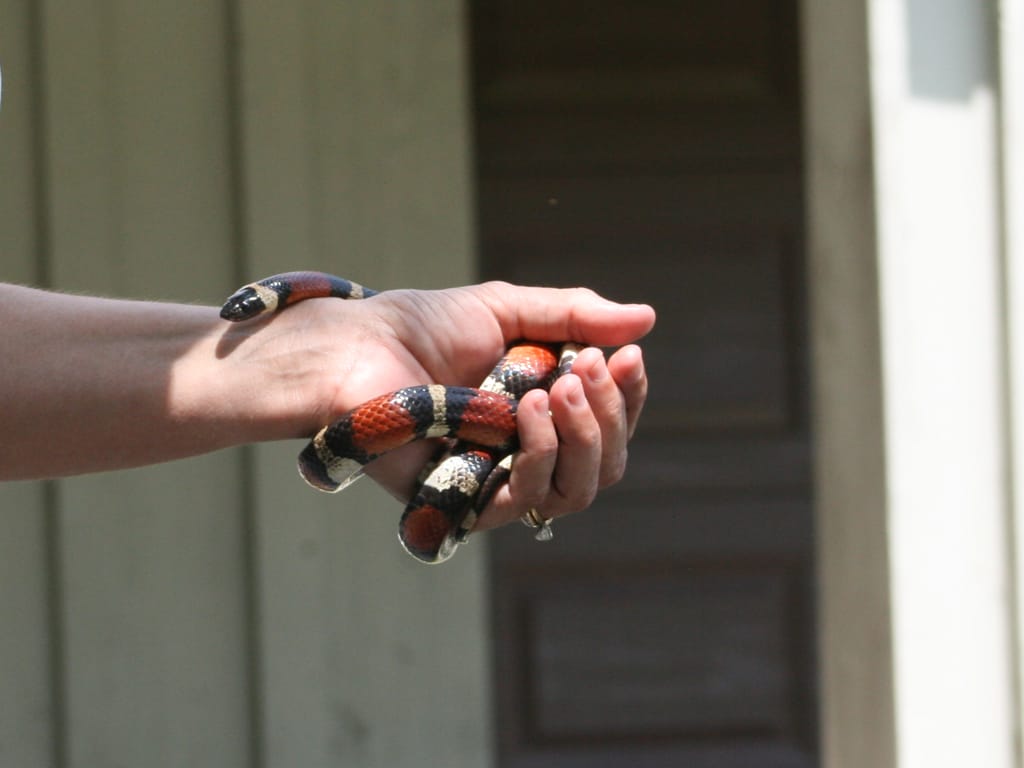
This image shows a hand holding a colorful snake with bands of red, black, and white. The snake appears to be resting on the person's skin, showcasing its distinctive pattern. The background is blurred, with hints of outdoor structures.
🔬 Scientific Phenomena
The image depicts an animal with unique physical characteristics. This relates to the phenomenon of animal adaptations and coloration. Specifically, the snake's band patterns are a visual trait that helps it survive in its environment. This coloration can serve as camouflage, a warning to predators, or mimicry of more dangerous species.
📚 Core Science Concepts
- Traits: Organisms, like this snake, have observable characteristics called traits. These traits can include physical features like color, pattern, size, and shape.
- Inheritance: Traits are passed down from parents to offspring through a process called heredity. This is why the snake has the specific band pattern it does.
- Environmental Influence: While many traits are inherited, some can be influenced by the environment. For example, diet or exposure to sunlight can sometimes affect an organism's appearance or health.
- Survival Advantages: Certain traits can provide an advantage for survival in a specific habitat. The snake's coloration might help it avoid being eaten by predators or help it sneak up on its prey.
Pedagogical Tip: Encourage students to observe and describe the snake's patterns and colors in detail. Prompt them to use descriptive language, focusing on factual observations rather than opinions.
UDL Suggestions: Provide visual aids such as diagrams or different snake images to compare and contrast patterns. Offer sentence starters for students who need support in articulating their observations about the snake's traits.
🔍 Zoom In / Zoom Out Concepts
- Zoom In: At a microscopic level, the snake's coloration comes from specialized cells called chromatophores in its skin. These cells contain pigments that absorb and reflect different wavelengths of light, creating the visible colors and patterns.
- Zoom Out: This snake is part of a larger ecosystem. Its role as a predator or prey affects other organisms, contributing to the balance of the environment. The snake's survival depends on the availability of food, water, shelter, and the absence of too many predators, all interconnected elements of its habitat.
🤔 Potential Student Misconceptions
- Misconception: All colorful snakes are dangerous or venomous.
Clarification: While some colorful snakes are venomous, many are not. The bright colors can sometimes be a warning, but it's important to learn about specific species. Many non-venomous snakes have evolved to mimic the warning colors of venomous ones to protect themselves. This snake's coloration may be a mimicry adaptation.
🎓 NGSS Connections
3-LS3-1: Analyze and interpret data to provide evidence that plants and animals have traits inherited from parents and that variation of these traits exists in a group of similar organisms.
3-LS3-2: Use evidence to support the explanation that traits can be influenced by the environment.
3-LS4-2: Use evidence to construct an explanation for how the variations in characteristics among individuals of the same species may provide advantages in surviving, finding mates, and reproducing.
K-LS1-1 (Grade K — foundational connection): Use observations to describe patterns of what plants and animals (including humans) need to survive.
💬 Discussion Questions
- What patterns do you notice in the snake's colors and bands? (Bloom's: Analyze | DOK: 2 | SEP: Analyzing and Interpreting Data)
- How might the snake's color pattern help it survive in its home? (Bloom's: Apply | DOK: 2 | SEP: Constructing Explanations and Designing Solutions)
- Why do you think animals have different traits? (Bloom's: Understand | DOK: 1 | SEP: Constructing Explanations and Designing Solutions)
📖 Vocabulary
- Traits: Specific characteristics or features of a living thing.
- Heredity: The passing of traits from parents to their offspring.
- Adaptation: A special feature or behavior that helps a living thing survive in its environment.
- Mimicry: When one living thing looks like another living thing, often for protection.
🌡️ Extension Activities
- Pattern Rubbings: Have students create their own snake designs by drawing or painting patterns. They can use different materials like sponges, q-tips, or stamps to create textured patterns.
- Habitat Dioramas: Students can create shoebox dioramas of different snake habitats, incorporating elements that would help a snake survive (e.g., camouflage, places to hide, sources of food).
🔗 Cross-Curricular Ideas
- Art: Students can draw, paint, or sculpt snakes, focusing on accurate color patterns and textures. They could also explore symmetry in the snake's patterns.
- ELA: Read books about snakes and discuss the descriptive language used to portray them. Students can write their own descriptive paragraphs about the snake in the picture.
- Math: Measure the length of different toy snakes or draw snakes to scale. Count the number of bands of each color.
🚀 STEM Career Connection
- Herpetologist — Studies reptiles and amphibians — snakes, lizards, frogs and turtles.
- Try it: Look at pictures of snakes in different habitats and record which patterns seem to blend in best. (Practice: Analyzing and Interpreting Data)
- Tools: snake hooks, pitfall traps, temperature probes, a field notebook
- Where they work: deserts and wetlands, zoos, natural history museums, universities
- Meet one: Earyn McGee — What happens to desert lizards when the streams they live near dry up.
- Median pay: /year — "Zoologists and wildlife biologists"
- Ecologist — Studies how living things depend on each other and on the place they live.
- Try it: Create a simple chart showing what the snake eats and what might eat the snake, based on its appearance. (Practice: Analyzing and Interpreting Data)
- Tools: quadrat frames, measuring tapes, GPS units, a field notebook
- Where they work: forests, grasslands, wetlands, universities
- Meet one: Sandra Díaz — What a plant's leaves, wood and shape tell you about how it lives — and how those traits add up across a whole ecosystem.
- Median pay: /year — "Environmental scientists and specialists, including health"
Wage figures are median annual wages for the U.S. occupation named after each one, from the U.S. Bureau of Labor Statistics, Occupational Employment and Wage Statistics (OEWS), national, May 2025. Several careers share one occupation, so their figures match.