📸 Photo Description
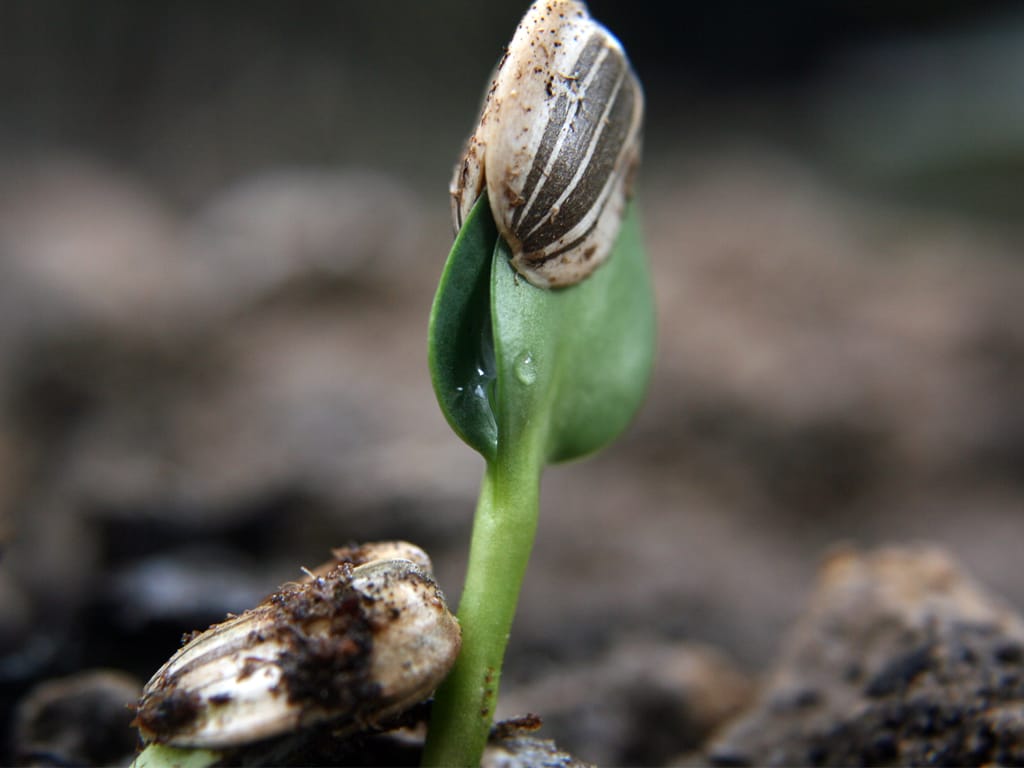
This image shows a small green plant sprouting from soil with two seed coats (the brown shells) still attached—one at the base and one at the top. The green stem is growing upward, and you can see the beginning of the plant's life cycle as it breaks out of its protective seed covering. The seeds are cracking open because a new plant is growing inside and needs to push its way out into the world.
🔬 Scientific Phenomena
Anchoring Phenomenon: Seed germination—the process where a seed breaks open and begins to grow into a plant.
Why It Happens (Scientific Explanation): Seeds are dormant (sleeping) packages containing a baby plant and stored food. When seeds get the right combination of water, warmth, and oxygen, they "wake up." The baby plant (embryo) absorbs water, swells inside the seed coat, and eventually cracks it open. The plant then uses the stored food in the seed to grow roots downward and a stem upward. This is nature's way of ensuring plants grow only when conditions are favorable for survival.
📚 Core Science Concepts
- Seed Structure: Seeds have protective outer coats, stored food for the baby plant, and an embryo (the tiny plant inside). The seed coat keeps the baby plant safe until it's ready to grow.
- Conditions for Growth: Seeds need three main things to germinate: water (to activate growth), warmth (to speed up the process), and oxygen (for the plant cells to function). Without these, seeds stay dormant.
- Life Cycles: Plants go through different stages of life—seed, sprout, seedling, mature plant, and reproduction. Germination is the beginning stage where a seed becomes a visible plant.
- Energy Transfer: Seeds store energy (food) inside them that the baby plant uses to grow before it can make its own food through photosynthesis once its leaves develop.
Pedagogical Tip:
Students at this age are concrete thinkers and learn best through direct observation. Rather than just showing this photo, consider planting bean seeds in a clear cup so students can watch germination happen over 1-2 weeks. They can draw daily observations and measure growth with a ruler. This transforms the photo from a static image into a personal discovery experience where they become scientists tracking real change.
UDL Suggestions:
To support diverse learners: (1) Provide a labeled diagram of seed parts alongside the photograph for visual learners; (2) Allow kinesthetic learners to manipulate a large seed model or actual soaked bean seeds to feel the softening seed coat and locate the embryo; (3) Create audio descriptions or use think-aloud protocols so students can hear scientific language modeled; (4) Offer a graphic organizer showing the germination sequence for students who need structured note-taking.
🎓 NGSS Connections
Performance Expectation: 3-LS1-1 Develop models to describe that organisms have unseen parts that help them survive, grow, and produce offspring.
Disciplinary Core Ideas:
- Growth and Development of Organisms—Plants require water, air, and energy to grow
- Inheritance of Traits—Individual traits vary and some traits are inherited from parents (seeds contain genetic information)
Crosscutting Concepts:
- The patterns of germination occur when specific conditions are met
- Water and warmth cause dormant seeds to germinate
💬 Discussion Questions
- What do you think is happening to the seed in this picture, and why do you think the seed coat is cracking open? (Bloom's: Understand | DOK: 2)
- What do you predict this plant will look like in two weeks? What does it need to keep growing? (Bloom's: Predict | DOK: 2)
- Why do you think seeds have hard outer coats that need to crack open? What problem do they solve? (Bloom's: Analyze | DOK: 3)
- If we kept a seed completely dry in a sealed bag, would it germinate? Explain your thinking. (Bloom's: Evaluate | DOK: 3)
📖 Vocabulary
- Germination: When a seed wakes up, absorbs water, and begins to grow into a plant.
- Seed Coat: The tough, protective outer shell of a seed that keeps the baby plant safe.
- Embryo: The tiny baby plant living inside a seed.
- Dormant: In a sleeping or resting state; seeds are dormant until conditions are right for growth.
- Sprout: The first visible shoot that emerges from a germinating seed.
- Oxygen: A gas in the air that living things, including sprouting seeds, need to survive.
🌡️ Extension Activities
- Seed Germination Observation Lab: Give each student a clear plastic cup with moist soil and a bean seed planted 1 inch deep. Have students observe and sketch the germination process daily for 2-3 weeks, measuring stem and root growth with a ruler. Create a class graph showing how fast different seeds germinate under identical conditions.
- Seed Dissection & Discovery: Provide soaked bean or sunflower seeds (soaking softens the coat). Students carefully open seeds with a plastic knife, locate the embryo, seed coat, and stored food, and match their findings to labeled diagrams. This hands-on exploration helps them understand hidden internal structures.
- Germination Condition Experiment: Set up three identical cups with seeds but vary one condition in each: (1) keep moist and warm; (2) keep dry in sunlight; (3) keep moist but in a cold location. Students predict which will germinate fastest and check daily. This teaches the scientific method and the importance of variables.
🔍 Zoom In / Zoom Out Concepts
Zoom In (Cellular Level): Inside the seed, plant cells are packed tightly together in the embryo and storage tissue. When water enters the seed, it's absorbed by individual cells, causing them to swell and push outward. The seed coat stretches and cracks because millions of tiny cells are expanding all at once—like filling balloons inside a paper bag until the bag bursts. At the cellular level, water moves into cells through a process called osmosis, and stored starches are broken down into sugars that the baby plant's cells use as fuel to divide and grow.
Zoom Out (Ecosystem & Seasonal Cycles): In nature, seed germination is connected to larger environmental patterns. A single sprouting seed like this one is part of a forest or garden ecosystem where hundreds of seeds germinate in spring when soil warms and rain falls. These seedlings become plants that provide food and shelter for insects, birds, and other animals. Over years, these plants help build soil, prevent erosion, produce oxygen, and store carbon dioxide. Zooming out further, germination is synchronized with Earth's seasonal cycles—seeds evolved to "know" when spring has arrived so they don't waste energy sprouting in winter's cold when they'd die. This is how plants respond to the planet's tilt and orbit around the sun.
🤔 Potential Student Misconceptions
Misconception 1: "The seed is dead until it germinates."
Clarification: Seeds are actually alive from the moment they're created on a parent plant. They're just in a dormant (sleeping) state, like a bear hibernating in winter. A dormant seed is still doing things inside—its cells are alive, just using very little energy. When water and warmth arrive, the seed "wakes up" and its cells become very active. A seed that's been stored dry for years can still germinate because the living embryo inside is just waiting for the right signal.
Misconception 2: "The seed coat breaks open because the plant is strong and pushing hard."
Clarification: The seed coat doesn't break because the baby plant is muscular or powerful. Instead, it breaks because water makes both the seed coat and the embryo swell. Imagine a balloon inside a bag—as the balloon fills with air, it pushes equally in all directions until the bag can't stretch anymore and tears. The swelling seed coat and expanding embryo push against each other until the coat splits at its weakest point. It's pressure and expansion, not strength or effort.
Misconception 3: "Once a seed sprouts, it no longer needs the seed coat or stored food."
Clarification: Even after germination, the sprouting seedling depends on the remaining stored food in the seed for several more days or weeks. The seed coat and remaining food supply are like a packed lunch for the journey. The sprout can't make its own food through photosynthesis yet because it needs leaves to develop first. Only when green leaves unfold and catch sunlight can the young plant begin making its own food and stop relying on the seed's storage.
🔗 Cross-Curricular Ideas
Math: Measuring & Graphing Growth — Students plant seeds and measure stem and root growth with a ruler every other day for two weeks. They record measurements on a chart and create a line graph showing how growth changes over time. This teaches measurement, data collection, and interpreting patterns. Extension: Compare the growth rates of different seed types (bean vs. corn vs. sunflower) and calculate which grew fastest.
ELA: Narrative & Informative Writing — Students write a "Life Story" from the seed's perspective: "My Life as a Bean Seed" from dormancy through germination and becoming a plant. This combines creative narrative with scientific vocabulary. Alternatively, students read The Tiny Seed by Eric Carle and write or illustrate their own version of a seed's journey, using "because" and "so" to explain cause-and-effect relationships.
Social Studies: Planting & Community Gardens — Connect germination to how communities grow food. Research where seeds come from (farmers, seed companies, heritage seed libraries). If possible, start a classroom or school garden together, discussing how plants feed people and communities. Students can map where the plants come from (home gardens, farms, stores) and learn that germination is a skill humans have used for thousands of years to survive.
Art: Seed & Nature Collage — Students collect actual seeds (bean seeds, sunflower seeds, pumpkin seeds, maple helicopters) and create collages or mosaics representing germination and growth. They can paint the stages of germination on a large leaf-shaped paper, then glue real seeds onto their artwork to represent the sprouting process. This multisensory approach helps kinesthetic learners connect texture and visual representation to the concept.
🚀 STEM Career Connection
- Agricultural Scientist — Works out how to grow more food on the same land without wearing the soil out.
- Try it: Design a simple solution to help seeds germinate faster by testing different warm temperatures, like placing one group of seeds in a sunny spot and another in a cooler spot. (Practice: Constructing Explanations and Designing Solutions)
- Tools: test plots, soil kits, seed drills, yield monitors
- Where they work: research farms, seed companies, extension services, universities
- Meet one: Segenet Kelemu — How to protect African food crops from disease, and how insects themselves can become food.
- Median pay: /year — "Soil and plant scientists"
- Horticulturist — Grows and cares for plants on purpose — choosing what will thrive in a particular place.
- Try it: Construct an explanation for why seeds need oxygen to germinate by observing seeds placed in water versus seeds placed in a sealed bag with air. (Practice: Constructing Explanations and Designing Solutions)
- Tools: pruning shears, soil test kits, grafting knives, greenhouses
- Where they work: botanical gardens, plant nurseries, city parks, farms and orchards
- Meet one: Carlos Magdalena — How to bring the world's rarest plants back from the edge, including the smallest water lily on Earth after it vanished from the wild.
- Median pay: /year — "Soil and plant scientists"
Wage figures are median annual wages for the U.S. occupation named after each one, from the U.S. Bureau of Labor Statistics, Occupational Employment and Wage Statistics (OEWS), national, May 2025. Several careers share one occupation, so their figures match.