📸 Photo Description
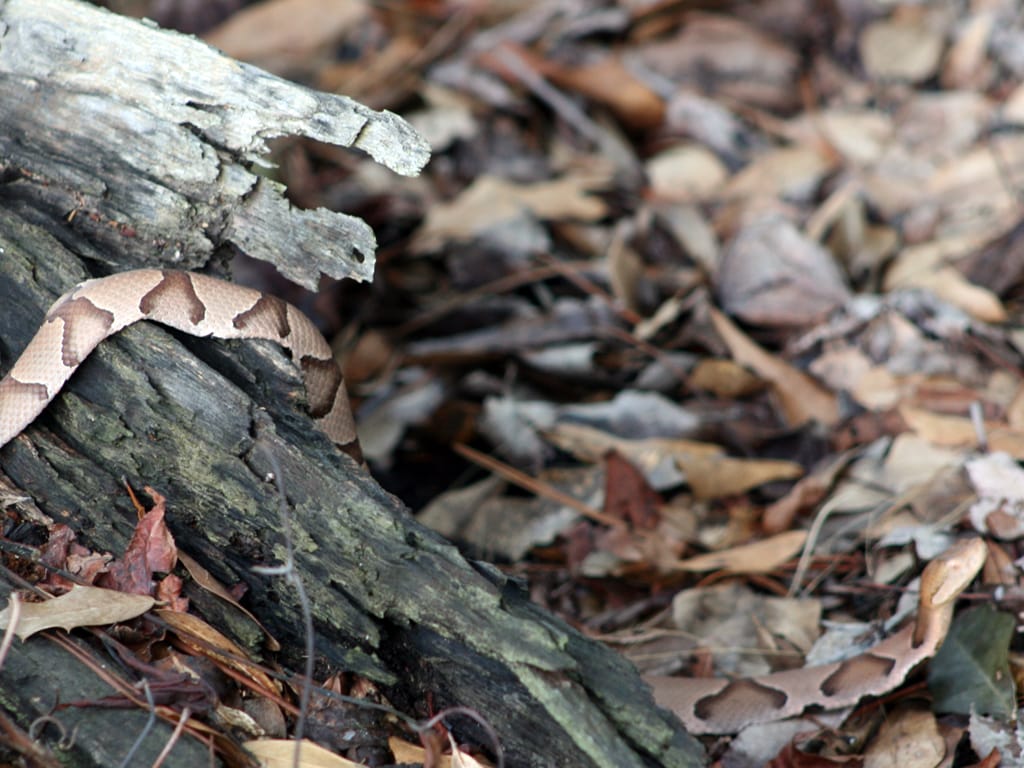
This photo shows a copperhead snake on a fallen log, partially hidden among dried leaves and forest debris. The snake's patterned scales blend in with the textures and colors of its environment, making it difficult to see. This natural camouflage helps the snake avoid predators and sneak up on prey.
🔬 Scientific Phenomena
The image illustrates the phenomenon of camouflage, a survival adaptation where an organism's coloring or markings help it blend in with its surroundings. This adaptation helps animals avoid being seen by predators or to hide from prey. In this specific image, the copperhead snake's coloration and pattern provide excellent camouflage against the bark of the log and the leaf litter on the forest floor.
📚 Core Science Concepts
- Adaptation for Survival: Organisms have traits, like camouflage, that help them survive in their specific environment. This allows them to find food, avoid being eaten, and reproduce.
- Camouflage: This is a specific type of adaptation where an animal's appearance matches its surroundings, making it harder to detect.
- Habitat: The environment where an organism lives, providing the things it needs to survive, such as food, water, and shelter. The fallen log and leaf litter represent the snake's habitat.
- Predator-Prey Relationships: Camouflage plays a crucial role in these relationships, helping predators catch prey and helping prey escape predators.
Pedagogical Tip: Encourage students to look closely at the photo and point out where they see the snake. This builds observation skills and highlights the effectiveness of camouflage.
UDL Suggestions: Provide a variety of images showing different animals with camouflage in various habitats. This offers multiple means of engagement with the concept of camouflage.
🔍 Zoom In / Zoom Out Concepts
- Zoom In: At a microscopic level, the snake's scales are covered in pigments that reflect certain wavelengths of light and absorb others, creating the specific colors and patterns that match the bark and leaves. The texture of the scales also contributes to breaking up the snake's outline.
- Zoom Out: This snake's camouflage is part of a larger ecosystem interaction. It helps the snake survive, which in turn affects the populations of its prey (like small rodents or lizards) and potential predators (like birds of prey or larger mammals). The health of the forest floor and the availability of hiding spots are also interconnected.
🤔 Potential Student Misconceptions
- Misconception: Students might think that camouflage is something an animal can "turn on and off" like a light.
Clarification: Camouflage is a permanent physical trait, like the color of a person's eyes or hair, that helps them blend in. It doesn't change based on the animal's will.
- Misconception: Students might believe that camouflage only means matching colors.
Clarification: Camouflage can also involve matching patterns, textures, or even mimicking the shape of an object in the environment to break up an animal's outline.
🎓 NGSS Connections
3-LS4-3: Construct an argument with evidence that in a particular habitat some organisms can survive well, some survive less well, and some cannot survive at all.
1-LS1-1 (Grade 1 — foundational connection): Use materials to design a solution to a human problem by mimicking how plants and/or animals use their external parts to help them survive, grow, and meet their needs.
💬 Discussion Questions
- How does the snake's pattern help it hide in its home? (Bloom's: Understand | DOK: 1 | SEP: Constructing Explanations and Designing Solutions)
- What other animals do you know that use camouflage to hide, and how do they do it? (Bloom's: Analyze | DOK: 2 | SEP: Obtaining Evaluating and Communicating Information)
- Why is it important for this snake to be able to hide from other animals? (Bloom's: Understand | DOK: 1 | SEP: Constructing Explanations and Designing Solutions)
📖 Vocabulary
- Camouflage: A special coloring or shape that helps an animal blend in with its surroundings.
- Habitat: The natural home or environment of an animal, plant, or other organism.
- Adaptation: A special trait or feature that helps an organism survive in its environment.
- Prey: An animal that is hunted and killed by another animal for food.
- Predator: An animal that hunts and kills other animals for food.
🌡️ Extension Activities
- Camouflage Creations: Have students use craft supplies (paint, construction paper, fabric scraps) to create their own camouflage patterns for paper cutouts of animals, aiming to blend them into different background scenes (forest, desert, ocean).
- Habitat Hunt: Go on a "habitat hunt" around the schoolyard or a local park. Students can draw or photograph different microhabitats (under a log, in tall grass, on a tree trunk) and discuss what kinds of animals might live there and how they might be camouflaged.
🔗 Cross-Curricular Ideas
- ELA: Read books about animal camouflage and have students write their own descriptive paragraphs about how a camouflaged animal hides.
- Art: Students can create collages using natural materials (leaves, twigs, dirt) to mimic a natural habitat and then try to "hide" a drawing or cutout of an animal within their artwork.
- Math: Measure the length of the snake in the photo (if possible, or provide a measurement). Students can then create bar graphs comparing the lengths of different camouflaged animals.
🚀 STEM Career Connection
- Entomologist — Studies insects — how they live, what they eat, and the jobs they do in an ecosystem.
- Try it: Argue with a partner about whether a brightly colored beetle or a brown moth is better camouflaged in a forest floor habitat, using evidence from pictures. (Practice: Engaging in Argument from Evidence)
- Tools: insect nets, a hand lens, pinning boards, microscopes
- Where they work: museums, farms, insect labs, universities
- Meet one: Corrie Moreau — How ants evolved together with the bacteria that live inside them.
- Median pay: /year — "Zoologists and wildlife biologists"
- Ornithologist — Studies birds — how they fly, what they eat, where they nest, and where they travel.
- Try it: Present evidence from bird guides to support the claim that a robin's brown feathers help it hide from predators in its nest. (Practice: Engaging in Argument from Evidence)
- Tools: binoculars, spotting scopes, leg bands, sound recorders
- Where they work: wildlife refuges, bird observatories, parks, universities
- Meet one: Corina Newsome — How seaside sparrows in salt marshes lose nests to rising water — nests built higher escape the flooding but become easier for predators to find.
- Median pay: /year — "Zoologists and wildlife biologists"
Wage figures are median annual wages for the U.S. occupation named after each one, from the U.S. Bureau of Labor Statistics, Occupational Employment and Wage Statistics (OEWS), national, May 2025. Several careers share one occupation, so their figures match.