📸 Photo Description
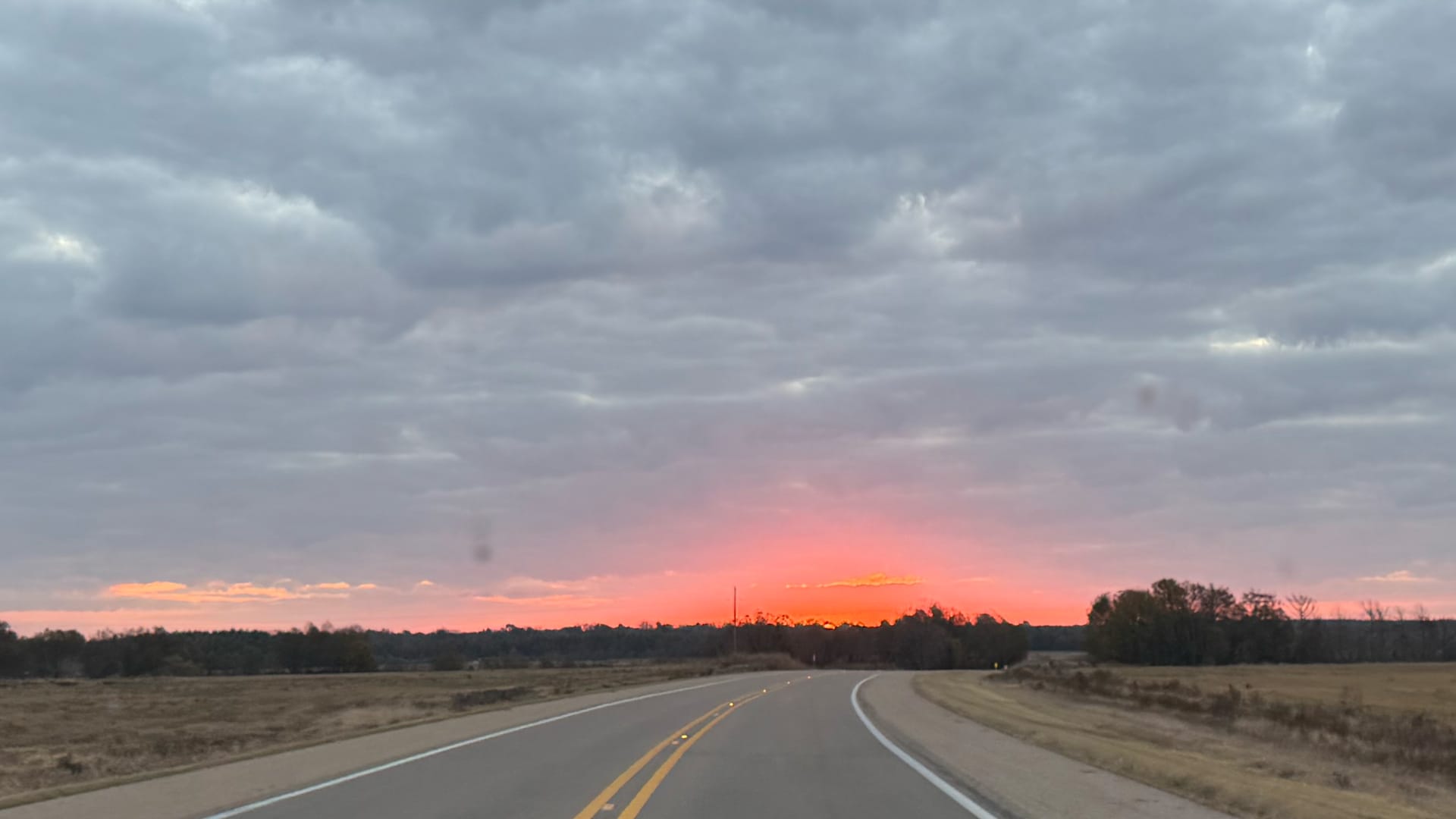
The image shows a road with fields and trees on either side, leading towards a vibrant orange and pink sky. This is a sunrise, with colorful clouds and the sun low on the horizon. The sky is partly cloudy, with darker clouds above.
🔬 Scientific Phenomena
This photo captures the phenomenon of sunrise, a daily event caused by the Earth's rotation. As the Earth spins, different parts of the planet face towards or away from the sun. Sunrise is the moment when the sun appears to rise above the horizon, marking the beginning of daytime. The colors are caused by the scattering of sunlight as it passes through the Earth's atmosphere.
📚 Core Science Concepts
- Earth's Rotation: The Earth spins on its axis, causing day and night and the apparent movement of the sun across the sky.
- Sunlight and Atmosphere: Sunlight is made of different colors. When sunlight enters the atmosphere, it interacts with gas molecules and particles. Shorter wavelengths (like blue and violet) are scattered more easily, while longer wavelengths (like red and orange) pass through more directly. At sunrise and sunset, sunlight travels through more atmosphere, scattering away most of the blue light and leaving the reds and oranges visible.
- Weather Conditions: Clouds play a role in how we see the sunrise. Different types and densities of clouds can affect the colors and intensity of the light.
Pedagogical Tip: When discussing sunrises and sunsets with third graders, encourage them to draw what they observe. This can help them process the visual information and articulate their understanding of the colors and patterns.
UDL Suggestions: Provide students with a variety of ways to demonstrate their understanding, such as drawing, writing a short narrative about a sunrise, or orally describing the phenomenon to a partner.
🔍 Zoom In / Zoom Out Concepts
- Zoom In: At a microscopic level, the colors of the sunrise are due to the way individual light waves, which are packets of energy, interact with tiny molecules of gases in the atmosphere. Blue light waves are shorter and bump into these molecules more, scattering in all directions. Red and orange light waves are longer and can travel through more of the atmosphere without being scattered as much, reaching our eyes.
- Zoom Out: Sunrise is a local manifestation of a much larger, continuous process of Earth's rotation relative to the Sun. This daily cycle drives weather patterns, influences plant growth through photosynthesis, and dictates the cycles of activity for many organisms. It is a fundamental part of the Earth-Sun system that impacts life on our planet.
🤔 Potential Student Misconceptions
- Misconception: Students might think the sun moves across the sky.
Clarification: The sun appears to move because the Earth is rotating on its axis. We are on a spinning planet, which makes it seem like the sun is rising and setting.
- Misconception: Students might think the sun is red or orange.
Clarification: The sun is actually white light, but the colors we see at sunrise and sunset are a result of how the sunlight is scattered by Earth's atmosphere.
🎓 NGSS Connections
- 3-ESS2-1: Represent data in tables and graphical displays to describe typical weather conditions expected during a particular season.
- 3-ESS2-2: Obtain and combine information to describe climates in different regions of the world.
💬 Discussion Questions
- What colors do you see in the sky, and where is the sun in relation to the horizon? (Bloom's: Remember | DOK: 1 | SEP: Obtaining Evaluating and Communicating Information)
- Why do you think the sky is colored this way during sunrise? (Bloom's: Analyze | DOK: 2 | SEP: Constructing Explanations and Designing Solutions)
- How is this scene different from what you would see at midday? (Bloom's: Analyze | DOK: 2 | SEP: Constructing Explanations and Designing Solutions)
📖 Vocabulary
- Sunrise: The time in the morning when the sun appears to come up over the horizon.
- Horizon: The line where the sky appears to meet the land or sea.
- Atmosphere: The layer of gases that surrounds the Earth.
- Scattering: When light waves bounce off of particles in the air and spread out in different directions.
🌡️ Extension Activities
- Sunrise/Sunset Observation Log: Have students observe and record the colors and appearance of the sky at sunrise or sunset over several days, noting any changes and possible reasons.
- Color Mixing with Light: Use flashlights and colored filters (or cellophanes) to demonstrate how mixing different colors of light can create new colors, relating this to how sunlight colors are seen.
🔗 Cross-Curricular Ideas
- ELA: Have students write a creative story or poem about a sunrise, focusing on descriptive language and sensory details.
- Art: Students can paint or draw their own interpretations of the sunrise, experimenting with color mixing to represent the vibrant sky.
- Social Studies: Discuss how different cultures historically viewed the sunrise and sun, and how time is measured using the sun's position.
🚀 STEM Career Connection
- Meteorologist — Studies the atmosphere to work out what the weather will do next.
- Try it: Predict the sunrise colors for tomorrow based on today's weather and draw what you expect. (Practice: Constructing Explanations and Designing Solutions)
- Tools: weather balloons, radar, rain gauges, computer models
- Where they work: weather stations, airports, television studios, research centres
- Meet one: Marshall Shepherd — Why cities make their own weather, and why some neighbourhoods flood before others.
- Median pay: /year — "Atmospheric and space scientists"
- Photographer — Makes pictures on purpose, controlling light, focus and timing to show what the eye would miss.
- Try it: Take photos of the sky at different times of the morning and compare how the light changes. (Practice: Constructing Explanations and Designing Solutions)
- Tools: cameras and lenses, lighting kits, tripods, editing software
- Where they work: studios, newsrooms, museums, science labs
- Median pay: /year — "Photographers"
Wage figures are median annual wages for the U.S. occupation named after each one, from the U.S. Bureau of Labor Statistics, Occupational Employment and Wage Statistics (OEWS), national, May 2025. Several careers share one occupation, so their figures match.