📸 Photo Description
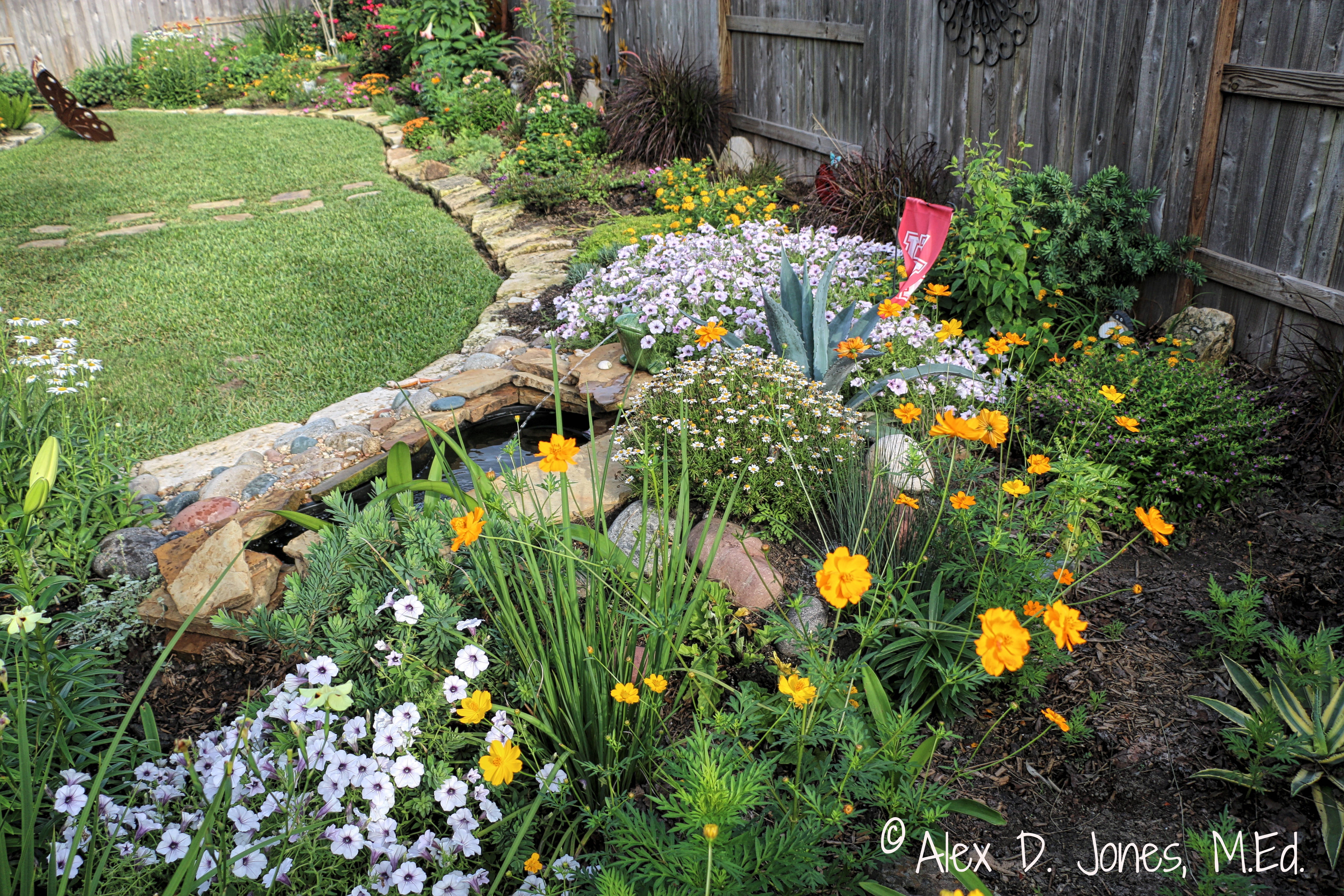
This backyard garden shows many different plants growing together. There are orange and purple flowers blooming, green grass, and plants of different sizes. The plants are arranged around a small water feature with rocks.
🔬 Scientific Phenomena
The Anchoring Phenomenon is a thriving garden ecosystem where different plants have specific needs that are being met in their environment. This is happening because each plant has adapted to use sunlight, water, and nutrients from the soil in different ways. The orange flowers (likely cosmos or marigolds) and purple flowers (possibly asters) are blooming because they are receiving the right amount of sunlight, water, and nutrients. The variety of plant heights and types shows how different species can coexist by occupying different niches in the same space - some plants grow tall to reach more sunlight, while others spread low to cover ground.
📚 Core Science Concepts
- Plant Life Cycles and Growth Requirements - Plants need sunlight, water, air, and nutrients from soil to survive and reproduce. The blooming flowers show plants in their reproductive stage.
- Habitat and Environmental Interactions - This garden provides a habitat where plants and animals can meet their basic needs. Different plants thrive in different parts of the garden based on sunlight and water availability.
- Biodiversity and Ecosystems - The variety of plant species creates a small ecosystem that can support different types of insects, birds, and other small animals.
Pedagogical Tip: Use the "See, Think, Wonder" thinking routine with this image. Have students first observe what they see, then think about what's happening, and finally wonder about questions they have. This builds scientific observation skills.
- Seasonal Changes and Plant Responses - The blooming flowers indicate the plants are responding to seasonal cues like temperature and daylight length.
UDL Suggestions: Provide multiple ways for students to document observations - drawing, photography, voice recordings, or digital tools. This supports different learning preferences and abilities while building scientific documentation skills.
🔍 Zoom In / Zoom Out Concepts
Zoom In: At the cellular level, plant cells in the leaves are using chloroplasts to capture sunlight energy and convert carbon dioxide and water into sugar through photosynthesis. Root cells are absorbing water and dissolved minerals from the soil particles.
Zoom Out: This backyard garden is part of a larger urban ecosystem that connects to regional food webs. The flowers attract pollinators like bees and butterflies that travel between many gardens, helping plants reproduce across the neighborhood and supporting biodiversity throughout the city.
🤔 Potential Student Misconceptions
- Misconception: Plants get their food from the soil like animals eat food.
Clarification: Plants make their own food using sunlight, water, and carbon dioxide from air. They get nutrients and water from soil, but not "food."
- Misconception: All plants need exactly the same amount of water and sunlight.
Clarification: Different plant species have evolved to thrive in different conditions - some need more water, others prefer shade or full sun.
- Misconception: Plants don't really need air.
Clarification: Plants need carbon dioxide from air to make food and oxygen to release energy, just like animals need air to breathe.
🎓 NGSS Connections
Performance Expectation: 3-LS4-3 - Construct an argument that some animals and plants have internal and external structures that function to support survival, growth, behavior, and reproduction.
Disciplinary Core Ideas:
- - Environmental changes affect organisms
- - Growth and development of organisms
Crosscutting Concepts:
- - Different plants have structures suited for their environment
- - The garden functions as an interconnected system
💬 Discussion Questions
- What evidence do you see that these plants are healthy and getting what they need to survive? (Bloom's: Analyze | DOK: 2)
- How might this garden look different in winter, and what would the plants need to survive? (Bloom's: Apply | DOK: 2)
- If you wanted to add a new plant to this garden, what would you need to consider about where to place it? (Bloom's: Evaluate | DOK: 3)
- What connections can you make between the different living and non-living parts of this garden system? (Bloom's: Synthesize | DOK: 3)
📖 Science Vocabulary
- Habitat: A place where plants and animals can find everything they need to live and grow.
- Nutrients: Important chemicals that plants absorb from soil to help them grow healthy and strong.
- Ecosystem: All the living and non-living things in an area that work together.
- Photosynthesis: The process plants use to make their own food using sunlight, water, and air.
- Biodiversity: Having many different types of plants and animals living in the same place.
- Pollinator: An animal like a bee or butterfly that helps plants make seeds by moving pollen between flowers.
🔗 Cross-Curricular Ideas
- Math - Measurement and Data Collection: Have students measure the height of different plants in the garden using non-standard units (like hand spans or craft sticks) or standard measurements (inches/centimeters). Create a bar graph showing which plants are tallest and shortest. This connects to measuring, comparing, and organizing data.
- ELA - Descriptive Writing and Poetry: Students can write sensory descriptions of the garden or create acrostic poems using plant names (FLOWER, GARDEN, SOIL). They could also write "how-to" instructions for planting a flower seed, practicing sequential writing and following directions.
- Social Studies - Community Gardens and Local Food Systems: Discuss how community gardens help neighborhoods by providing fresh plants, bringing people together, and supporting local environments. Students could research or draw pictures of gardens in their own community and think about how gardens help people live healthier lives.
- Art - Color and Nature Observation: Students can create mixed-media garden art by painting, drawing, or creating collages inspired by the garden's colors and textures. They could also press flowers or leaves to create nature art projects that celebrate the beauty and variety of plants.
🚀 STEM Career Connection
- Entomologist — Studies insects — how they live, what they eat, and the jobs they do in an ecosystem.
- Try it: Observe the garden for insects and draw the different kinds you find and where they are on the plants. (Practice: Analyzing and Interpreting Data)
- Tools: insect nets, a hand lens, pinning boards, microscopes
- Where they work: museums, farms, insect labs, universities
- Meet one: Corrie Moreau — How ants evolved together with the bacteria that live inside them.
- Median pay: /year — "Zoologists and wildlife biologists"
- Biologist — Studies living things of every kind and what keeps them alive.
- Try it: Choose one plant and count how many flowers it has. (Practice: Analyzing and Interpreting Data)
- Tools: microscopes, sample jars, measuring tools, a field notebook
- Where they work: laboratories, field sites, museums, universities
- Meet one: Sandra Díaz — What a plant's leaves, wood and shape tell you about how it lives — and how those traits add up across a whole ecosystem.
- Median pay: /year — "Biological scientists, all other"
Wage figures are median annual wages for the U.S. occupation named after each one, from the U.S. Bureau of Labor Statistics, Occupational Employment and Wage Statistics (OEWS), national, May 2025. Several careers share one occupation, so their figures match.