📸 Photo Description
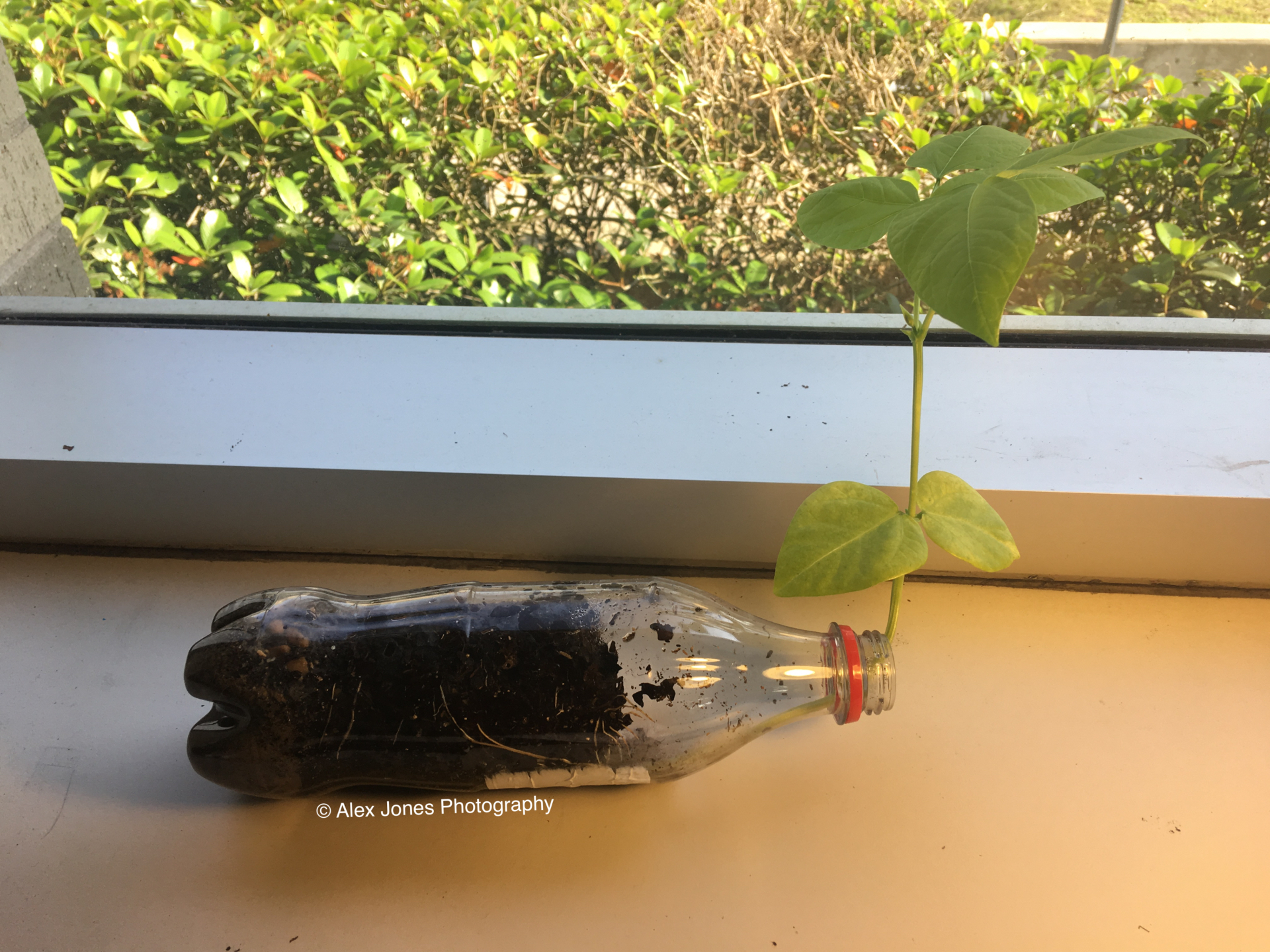
A young green plant with heart-shaped leaves is growing in a dark bottle filled with soil and water. The bottle is placed on a windowsill near a garden. This shows how plants can grow in different containers and use water and sunlight to survive and get bigger.
🔬 Scientific Phenomena
Anchoring Phenomenon: Plant growth and survival in a human-made habitat.
Plants are living things that need three main things to survive and grow: water, sunlight, and soil (nutrients). In this image, the plant has been placed in a bottle with soil that contains nutrients, and it receives water. When the plant sits on the windowsill near the window, it gets sunlight. All three of these needs are being met, so the plant can grow taller and produce new leaves. This demonstrates that plants are flexible organisms that can adapt to different growing environments—including human-created ones like recycled bottles. The plant is also showing us that humans can reuse materials to help plants survive, which connects to environmental stewardship.
📚 Core Science Concepts
- Plants are living things that have basic needs: Plants need water, sunlight, and nutrients (found in soil) to survive and grow, just like animals need food, water, and air.
- Living things grow and change: This plant started as a tiny seed or cutting and has grown bigger by producing new leaves. Growth is a characteristic of all living things.
- Living things can live in different habitats: While plants naturally grow in soil outdoors, this plant shows that living things can adapt and survive in human-made environments like bottles, as long as their basic needs are met.
- Humans can help plants survive: We can reuse materials (like bottles) and provide plants with water and light. This shows the relationship between humans and other living things.
Pedagogical Tip:
For Kindergarteners, use observable, concrete language when discussing plant needs. Instead of "photosynthesis," say "the plant drinks water from the soil and eats sunlight to grow." Have students physically touch soil, water a plant, and feel warmth from sunlight to make these needs tangible and memorable.
UDL Suggestions:
Multiple Means of Representation: Show the image on a screen while also bringing in a real plant students can observe directly. Some learners benefit from seeing the phenomenon both in photos and in person.
Multiple Means of Action & Expression: Allow students to express understanding through drawing pictures of what plants need (water, sun, soil) rather than only through verbal responses. Create a classroom "plant needs" poster where students draw or paste pictures of these three things.
Multiple Means of Engagement: Connect to students' lives by asking, "Do you have plants at home?" and sharing stories about growing things. This builds relevance and motivation.
🔍 Zoom In / Zoom Out Concepts
Zoom In: The Unseen Processes
At the microscopic level, the plant's roots are absorbing water and dissolved nutrients from the soil through tiny root hairs. Inside the leaves, chlorophyll (a green pigment) captures sunlight energy and converts it into chemical energy the plant uses to build new cells and tissues. These processes happen invisibly but are essential for the plant to grow bigger and stronger.
Zoom Out: The Larger System
This bottle plant is part of a larger ecosystem and human community. Outdoors, plants like this one provide oxygen for animals to breathe, food for herbivores, and habitat for insects. When humans grow plants indoors or reuse bottles for gardening, we're participating in sustainable practices that help the environment. This single plant connects to global concerns about conservation, recycling, and environmental responsibility.
🤔 Potential Student Misconceptions
- Misconception: "Plants eat soil like we eat food."
- Scientific Clarification: Plants don't eat soil the way animals eat food. Instead, roots absorb water and tiny nutrients from the soil. The plant makes its own food using sunlight, water, and air through a special process in the leaves.
- Misconception: "Plants don't need water if they sit in the sun."
- Scientific Clarification: Plants need both water AND sunlight. Water is just as important as light. Without water, even a plant in bright sun will wilt and die because roots cannot get the water they need to help the plant grow.
- Misconception: "This plant is growing in a bottle, so it's not a real plant or it's dying."
- Scientific Clarification: This is absolutely a real, healthy plant! Plants can grow in many different homes—in soil outdoors, in pots, in bottles, or even in water. As long as they get water, light, and nutrients, they can survive and grow in different places.
🎓 NGSS Connections
K-LS1-1: Use observations to describe patterns of what plants and animals (including humans) need to survive.
- All organisms have basic needs. For example, animals need air, water, and food; plants require air, water, nutrients, and light. Organisms can survive only in environments in which their needs can be met. The distribution and abundance of organisms and populations in an environment are limited by the availability of physical and biological resources and by such factors as quantities of light and water, range of temperatures, and soil composition.
- Students observe that plants and animals need specific things to survive, revealing patterns about what living things require.
- When a plant receives water, sunlight, and nutrients, it grows (cause → effect). Without these needs met, plants cannot survive.
💬 Discussion Questions
- "What do you think this plant needs to keep growing big and healthy?" (Bloom's: Remember | DOK: 1)
- "Why did the person put the plant by the window instead of in a dark corner?" (Bloom's: Understand | DOK: 2)
- "If we stopped giving this plant water, what would happen to it? Why?" (Bloom's: Analyze | DOK: 2)
- "How is this plant similar to you? What do both of you need to live and grow?" (Bloom's: Analyze | DOK: 3)
📖 Vocabulary
- Plant: A living thing that grows in soil, has leaves and roots, and needs water, sunlight, and nutrients to survive.
- Roots: The parts of a plant that grow down into the soil to drink water and get food for the plant.
- Sunlight: Bright energy from the sun that plants need to make food and grow tall and strong.
- Nutrients: Special tiny foods in soil that plants need to grow healthy and big.
- Habitat: A home or place where a living thing lives and finds everything it needs to survive.
- Grow: To get bigger and taller over time; a change that happens to all living things.
🌡️ Extension Activities
- "Plant Detective" Observation Walk: Take students on a nature walk around the school or classroom to find plants growing in different places (flower beds, window boxes, pots, cracks in sidewalks). Have them draw or point out where they see plants and discuss: "What does this plant have that helps it survive here?" (water, soil, sunlight, etc.)
- Bottle Plant Experiment: Provide each student (or pairs) with a small recycled bottle, soil, and seeds or a small plant cutting. Have them set up their own bottle plant on a classroom windowsill. Over 2-4 weeks, students water their plants and observe changes. Create a simple chart where students draw or place stickers showing if their plant is getting water (✓), sunlight (✓), and soil (✓). Discuss: "Why is your plant growing?"
- Plant Needs Sorting Game: Create three labeled boxes or areas: "Water," "Sunlight," and "Soil." Give students picture cards showing these things plus other objects (rocks, toys, etc.). Students sort and place cards in the correct "needs" category. Then discuss: "Plants need ALL THREE of these things. What happens if we take one away?"
🔗 Cross-Curricular Ideas
- Math: Create a simple growth chart. Have students measure their classroom plant with blocks or a ruler every week and record the height. Create a bar graph showing the plant getting taller. Discuss: "Is our plant growing? How much did it grow this week?"
- ELA/Literacy: Read the book The Tiny Seed by Eric Carle. Discuss how the seed grew into a big plant, just like the plant in the bottle. Have students dictate or draw their own story: "I planted a seed and it grew into..."
- Social Studies: Discuss how people around the world grow plants in different ways—some in big gardens, some in small pots, some in bottles. Show pictures of greenhouses, rooftop gardens, and home gardens. Talk about how humans care for plants.
- Art: Have students create a collage or painting showing a plant and all the things it needs to survive (draw the sun, water drops, soil, etc.). Display student work with the classroom plant as inspiration.
🚀 STEM Career Connection
- Botanist — Studies plants — how they grow, how they reproduce, and how they survive where they live.
- Try it: Construct an explanation for why the plant's roots are important for its survival in this water-based system. (Practice: Constructing Explanations and Designing Solutions)
- Tools: a hand lens, a plant press, a soil probe, field guides
- Where they work: botanical gardens, herbariums, forests and fields, universities
- Meet one: Robin Wall Kimmerer — Mosses — which she calls the coral reefs of the forest — and what Indigenous knowledge teaches about bringing plants back.
- Median pay: /year — "Soil and plant scientists"
- Horticulturist — Grows and cares for plants on purpose — choosing what will thrive in a particular place.
- Try it: Design a solution to provide a plant with light and air if it were growing in a dark, enclosed space. (Practice: Constructing Explanations and Designing Solutions)
- Tools: pruning shears, soil test kits, grafting knives, greenhouses
- Where they work: botanical gardens, plant nurseries, city parks, farms and orchards
- Meet one: Carlos Magdalena — How to bring the world's rarest plants back from the edge, including the smallest water lily on Earth after it vanished from the wild.
- Median pay: /year — "Soil and plant scientists"
Wage figures are median annual wages for the U.S. occupation named after each one, from the U.S. Bureau of Labor Statistics, Occupational Employment and Wage Statistics (OEWS), national, May 2025. Several careers share one occupation, so their figures match.