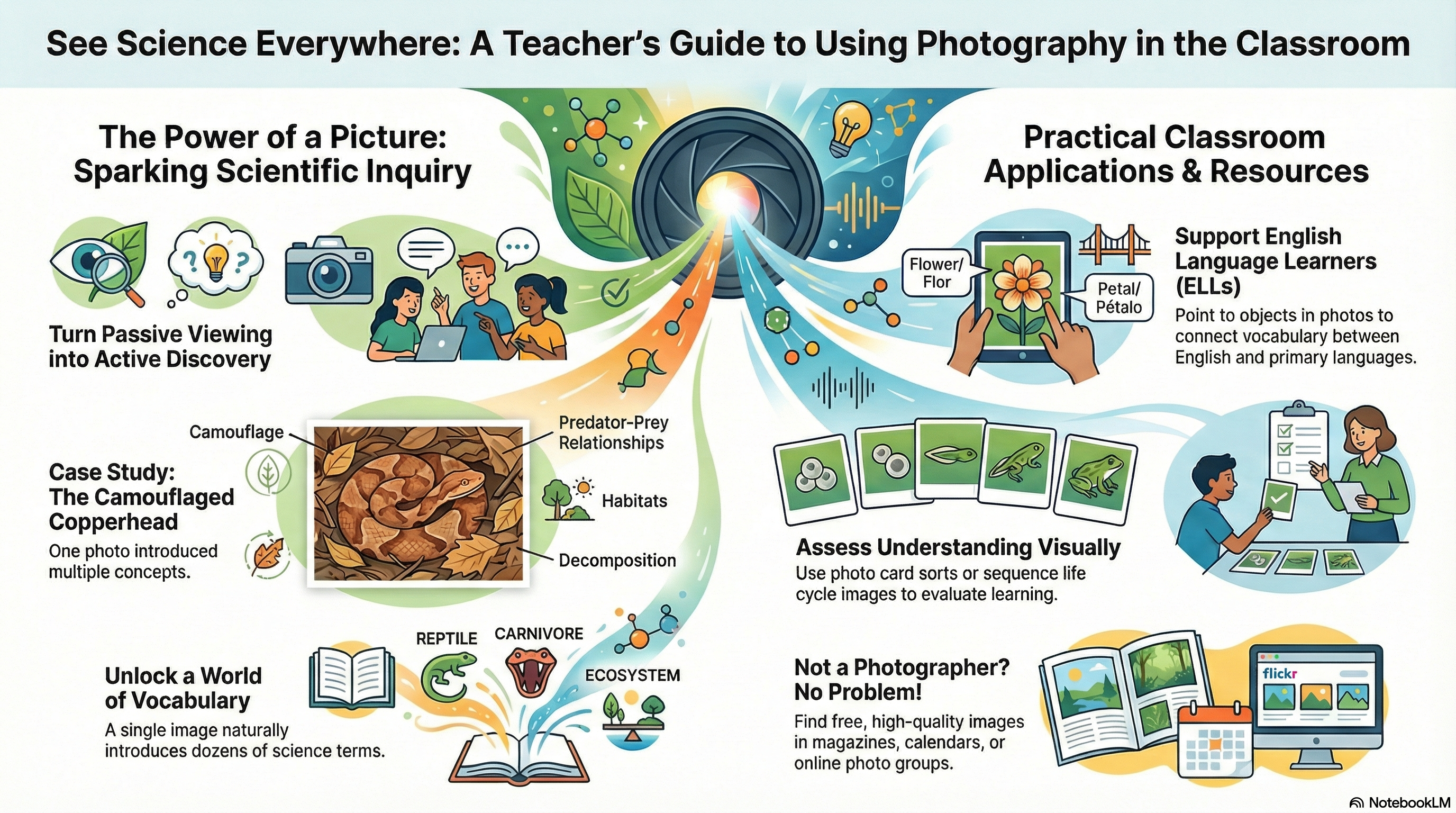
Research-based strategies that use the photograph as an entry point — making science
observable, discussable, and accessible for multilingual learners and the communities they
come from.
What guides the choice of image, the questions asked of it, and the supports built around it.
01
Visual Documentation
Photography turns abstract science concepts into tangible, accessible experiences that connect classroom content to students' lived worlds.
02
Cultural Responsiveness
Students' cultural backgrounds, community knowledge, and home languages are treated as assets in science, not obstacles to it.
03
Student-Centered Inquiry
Moving from teacher-directed instruction to student-driven investigation: asking questions, gathering evidence, constructing understanding.
04
Multimodal Communication
Multiple ways to access, process, and express scientific thinking — image, text, speech, and action together.
05
Phenomena-Based Learning
Instruction grounded in observable, personally relevant phenomena motivates authentic investigation of the real world.
06
Equity & Access
All learners — particularly multilingual students — get the support, resources, and high expectations they need to succeed.
How the materials work
What a multilingual learner actually gets
Not a philosophy statement. Every line below links to the real thing inside a real lesson — open one and look.
01
Strategies written for this photograph
Not a generic handout. Every photograph carries its own English Learner strategies, written for that image and that grade band, with a Spanish version alongside.
Each strategy is tagged by English proficiency band. A teacher with newcomers narrows to Levels 1–2 and sees only what fits them, instead of reading past what does not.
Support sits next to the discussion question it scaffolds, not in an appendix. Where a strategy fits the whole lesson rather than one question, it stays in the panel — anchoring it anywhere would be a guess.
Not a translated summary. The lesson, the discussion questions, the strategies and the printables all exist in Spanish, and one toggle switches the entire page.
A one-page family activity in English and Spanish, needing nothing a family has to buy. It ends with a question the child asks an adult — one their family can answer and the school cannot.
There are literally millions of potentially interesting things in the world to see, to do, to learn about. But they don't become actually interesting until we devote attention to them.
Philip Bell, Deb Morrison & Angela DeBarger · STEM Teaching Tool #31
No. 04 IQWST
How does a Driving Question Board promote the shift from ‘learning it’ to ‘figuring it out’?
How a Driving Question Board serves as a visual reference tool to help students and teachers track learning progress throughout a science unit.
The Driving Question Board serves as a visual reference to focus students' attention, record what they have learned, show where they have been and where they are going.
Activate Learning IQWST
No. 05 2019
Quick Reference Guide: Phenomena in the Classroom
What phenomena are in science education and how to use them effectively — a scientific phenomenon is an observable event that students can investigate.